01 · The discovery
The idea, in everyday language
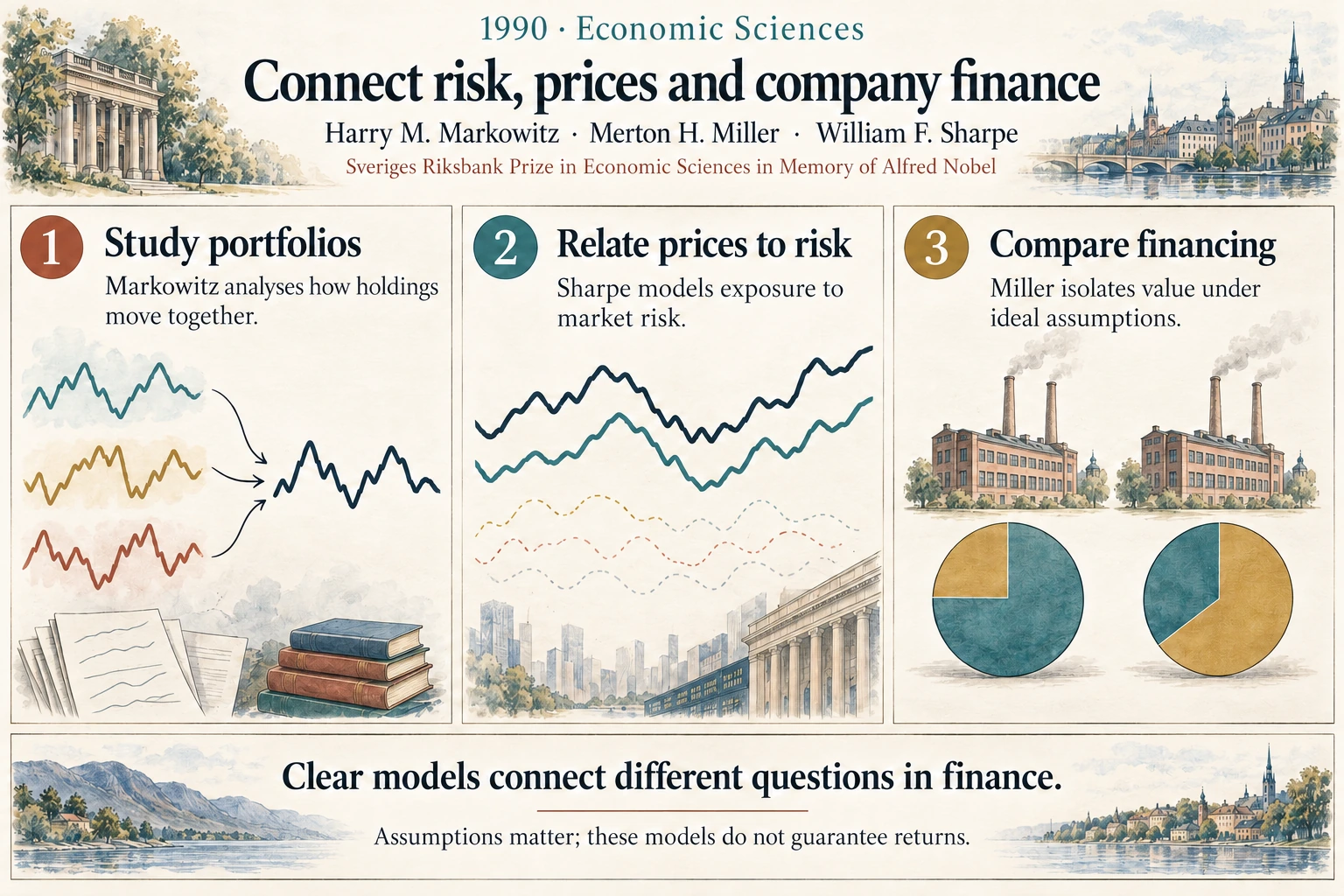
Markowitz asked how to choose a portfolio when returns are uncertain. Its risk depends not only on the variability of each holding, but also on how holdings move together. His mean–variance framework made those relationships explicit. Sharpe then connected expected returns to exposure to market risk under equilibrium assumptions: risk that can be diversified away differs from risk shared with the market.
Miller, working with Modigliani, examined how a company’s financing affects value. Under restrictive conditions, changing the mix of debt and equity need not change the total value of a fixed set of investments. This benchmark directs attention to taxes, distress and other real-world conditions that make financing matter. Together these contributions helped establish financial economics as a field using clear models that can be tested and questioned.
Why it matters
The work reshaped portfolio analysis, thinking about the risk in asset prices and corporate-finance research. Markowitz, Miller and Sharpe each received one third of the Sveriges Riksbank Prize in Economic Sciences in Memory of Alfred Nobel. Their theories provide ways to organise questions and evidence; they are not instructions to buy a particular asset or borrow a particular amount.