01 · The discovery
The idea, in everyday language
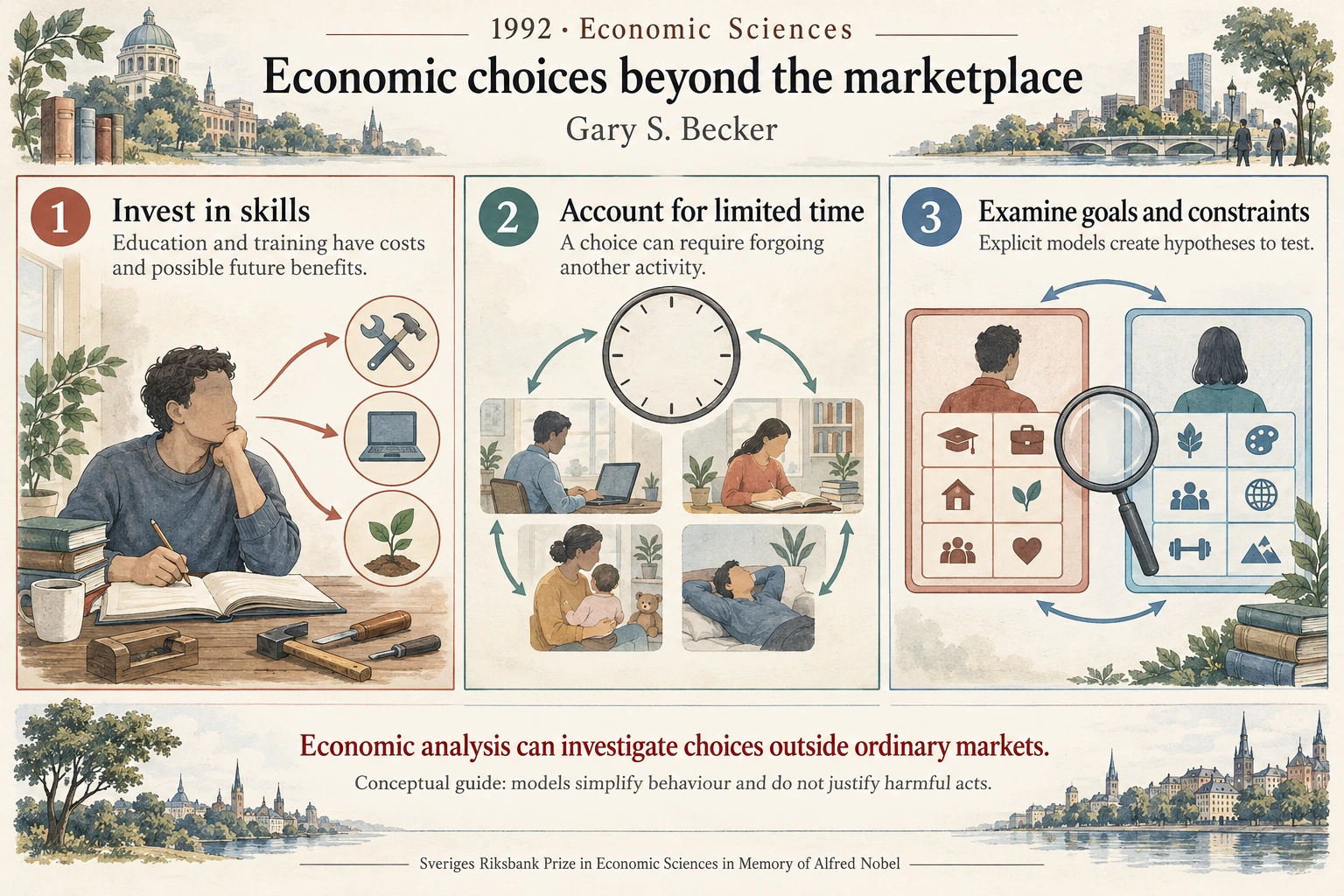
Economic analysis had often focused on prices, firms and market exchange. Becker extended it to choices about learning, the allocation of household time, discrimination and crime. His approach made goals and constraints explicit: pursuing one activity uses resources and means forgoing another. These opportunity costs can matter even when no money changes hands.
Education and training can be analysed as investments in human capital, with costs now and possible benefits later. Household models include the time needed to produce meals, care and other activities. Models of discrimination and crime ask how incentives and constraints affect behaviour. The contribution was a research programme spanning different domains, not one equation that fully explains every person.
Why it matters
Becker broadened what economists considered legitimate research questions and helped develop empirical work on human capital and social behaviour. His models stimulated discussion across economics, sociology and demography. Making assumptions explicit provides something to investigate and challenge; the assumptions do not become facts merely because a model is mathematically clear.