01 · The discovery
The idea, in everyday language
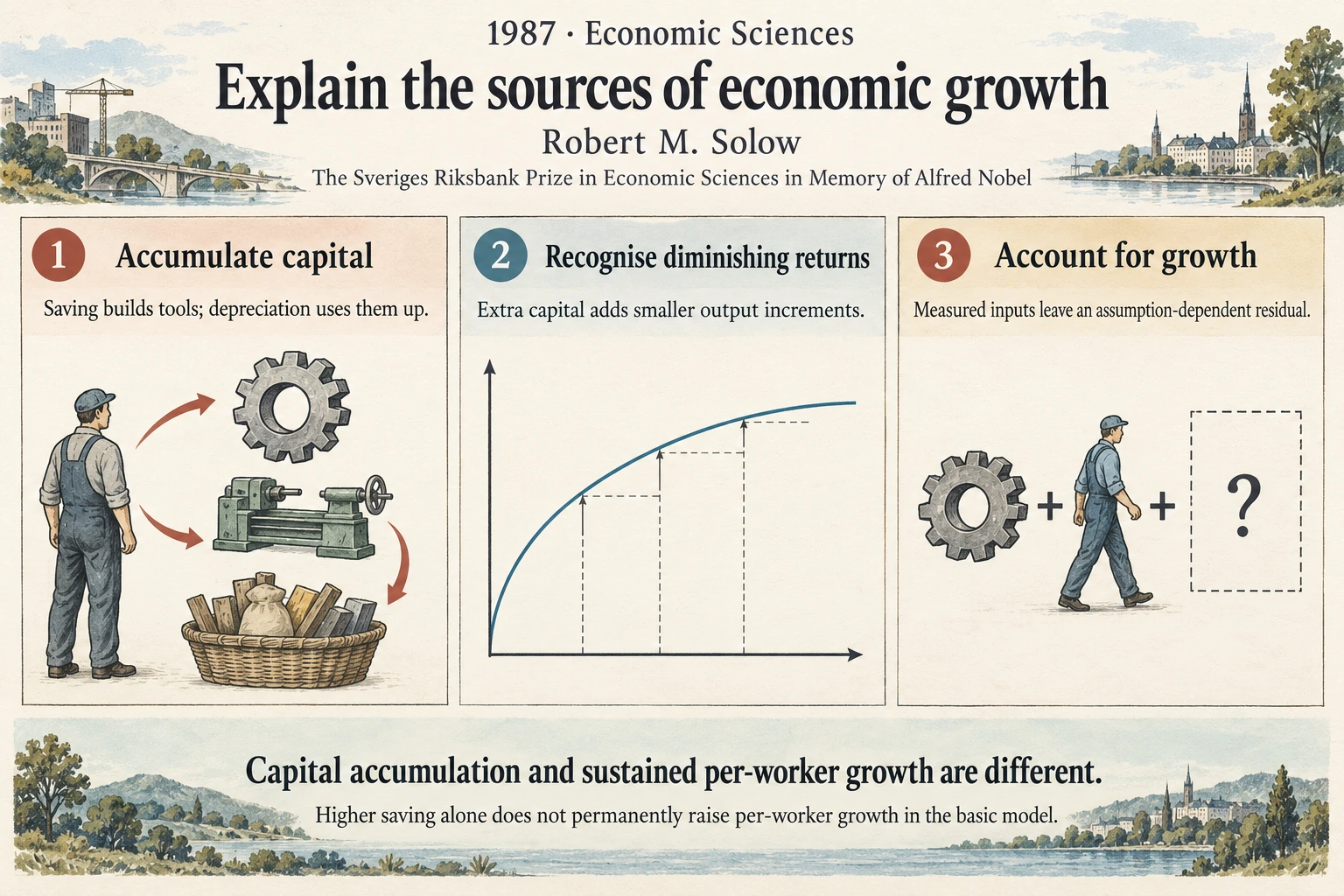
In Solow’s basic growth model, output depends on capital and labour, and capital accumulates through saving while also depreciating. With diminishing returns, adding more capital per worker yields smaller extra increments of output. A higher saving rate can raise the eventual output level and transitional growth without permanently raising per-worker growth by itself.
Sustained per-worker growth in the model requires technological progress, introduced as an external process. In separate growth-accounting work, Solow estimated how changes in capital and labour relate to output growth. The remaining residual is calculated under assumptions; it is not a direct, pure measurement of technology or proof of a single cause.
Why it matters
The 1956 model and 1957 growth-accounting paper gave researchers a framework for studying long-run growth. Later work considered technology embodied in new capital and many departures from the basic assumptions. Solow received the full Sveriges Riksbank Prize in Economic Sciences in Memory of Alfred Nobel for contributions to economic growth theory.