01 · The contribution
The idea, in everyday language
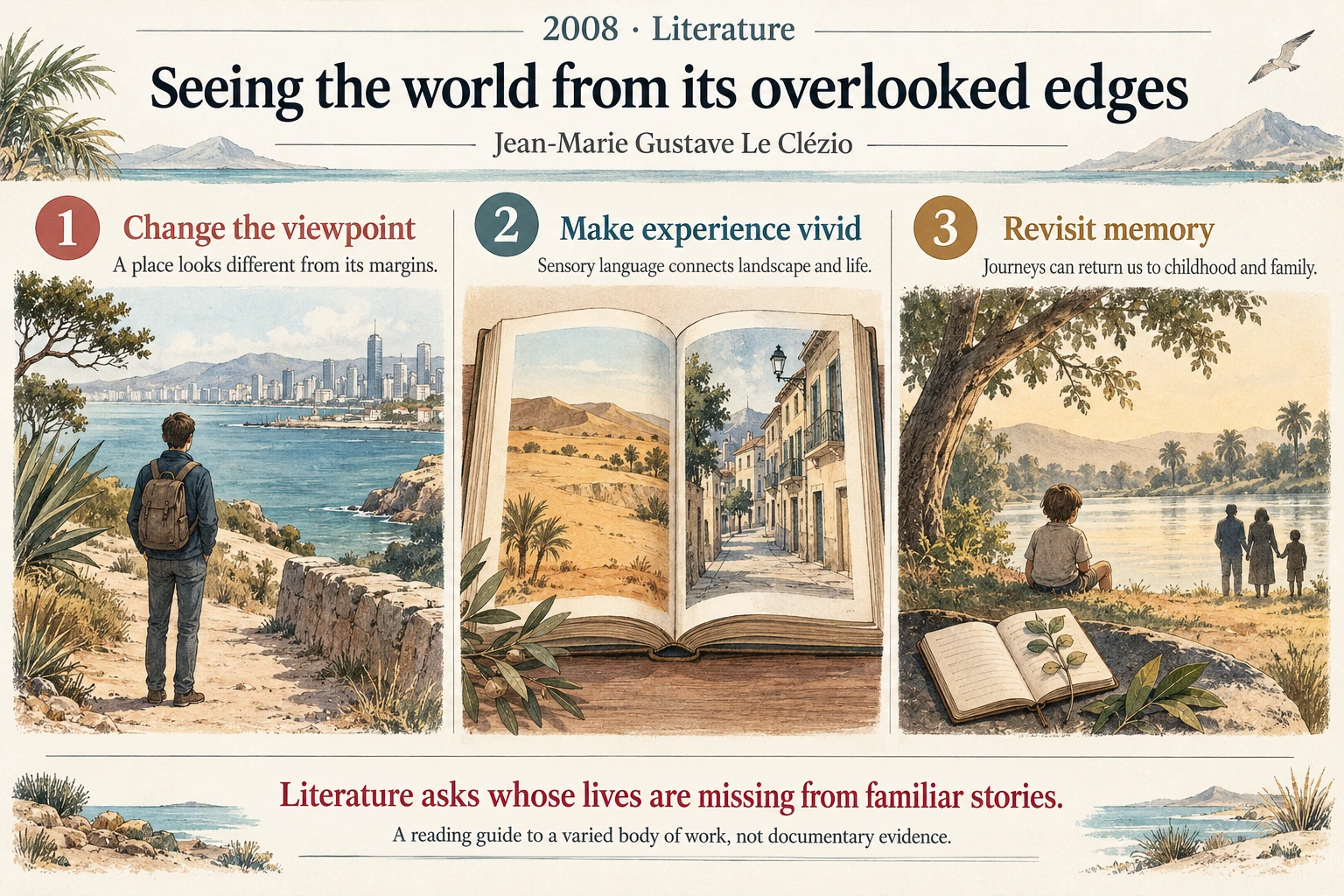
A city can look very different to someone who belongs securely within it and someone arriving from elsewhere. Le Clézio repeatedly changes the position from which a world is seen. His fiction explores displacement, childhood, encounters between cultures and the pressure of modern ways of life. Physical sensations—light, heat, water, noise—help make those experiences immediate rather than merely abstract.
His writing developed from the experiments and urban unease of Le procès-verbal toward works such as Désert, which juxtaposes a North African desert history with a young woman’s life in Europe. Later books also explore family memory and childhood, including Onitsha and L’Africain. These works differ in form and setting, but repeatedly ask whose experience is excluded when a society describes its own progress.
Why it matters
The work expands the lives, places and cultural encounters that literature invites readers to notice. Its sensory prose connects questions of migration, domination and belonging with individual experience. The prize recognised an exploratory body of writing rather than a scientific discovery, political programme or single definitive account of a culture.