c.curionodeThe Nobel Archive

2017 · Peace

Turning humanitarian concern into a treaty

ICAN helped organise civil-society support for a prohibition of nuclear weapons, keeping human consequences at the centre.

Humanitarian consequencesCivil-society campaigningNuclear disarmament
2017Peace

Visual guide

The prize, pictured

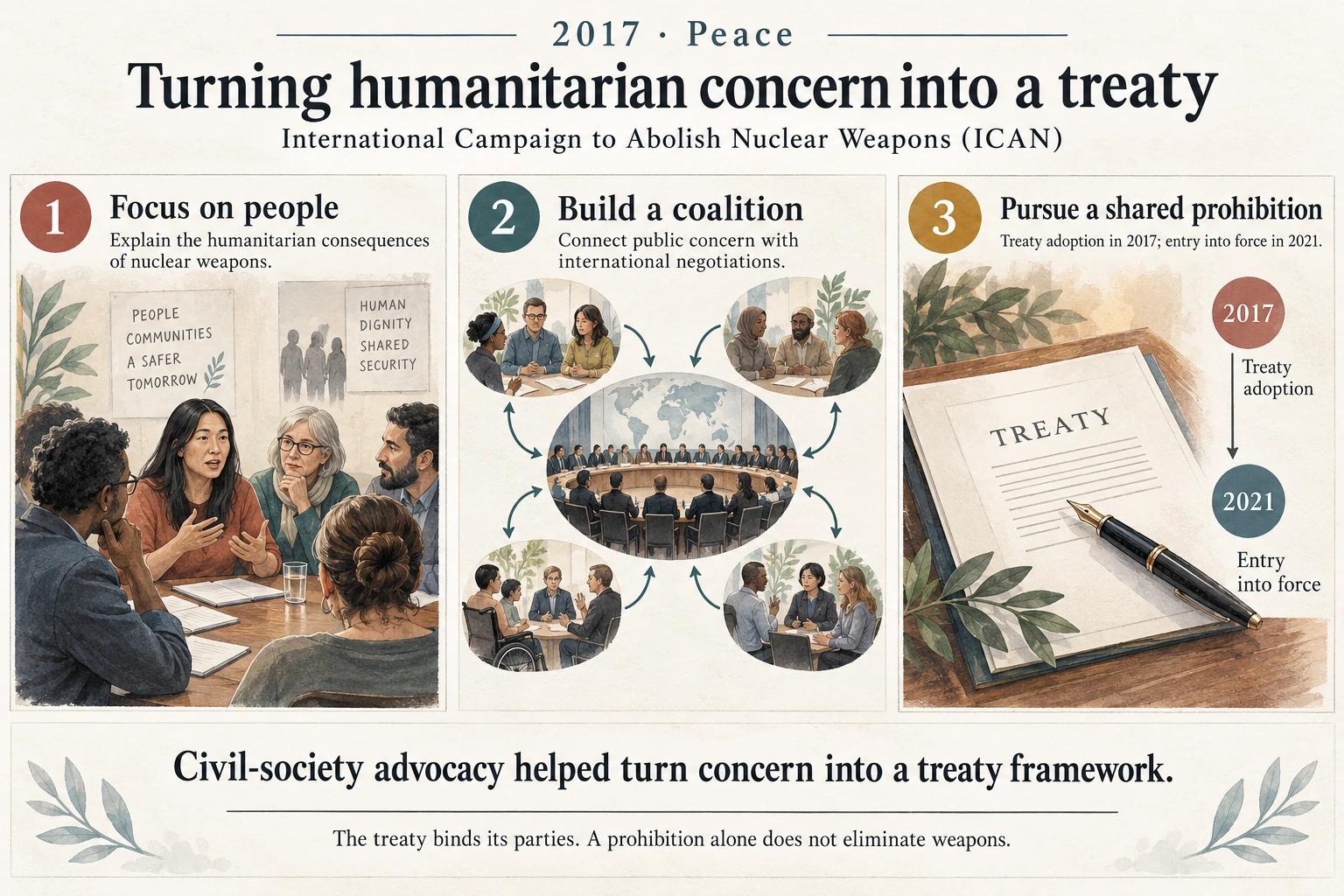
Infographic explaining Turning humanitarian concern into a treaty
Original AI-generated infographic. A conceptual overview; the explanations and sources below provide context.
Read the poster text

Civil-society advocacy helped turn concern into a treaty framework.

  1. Focus on people

    Explain the humanitarian consequences of nuclear weapons.

  2. Build a coalition

    Connect public concern with international negotiations.

  3. Pursue a shared prohibition

    Treaty adoption in 2017; entry into force in 2021.

The treaty binds its parties. A prohibition alone does not eliminate weapons.

01 · The contribution

The idea, in everyday language

Debates about nuclear weapons often begin with strategy and deterrence. The International Campaign to Abolish Nuclear Weapons asked governments and the public to give central attention to their humanitarian consequences. A nuclear detonation would affect people far beyond military decision-makers. By bringing partner organisations together, supporting public engagement and contributing to international meetings, ICAN worked to turn concern about those consequences into pressure for a legal prohibition.

On 7 July 2017, 122 states voted to adopt the Treaty on the Prohibition of Nuclear Weapons at the United Nations. ICAN was a leading civil-society participant in the process; states negotiated and adopted the treaty. The Nobel Committee recognised the campaign’s contribution while explicitly noting that a prohibition would not by itself eliminate a single weapon. Adoption in 2017 was followed by the treaty’s entry into force on 22 January 2021 for its parties.

Why it matters

The campaign showed how civil-society organisations can influence an international agenda by connecting public concern with negotiations. The treaty created a framework for participating states and strengthened the political argument for prohibition. The contribution is a form of humanitarian advocacy and diplomacy, rather than a scientific invention.


02 · The recipients

Who brought the idea to life?

03 · Years in the making

The path here

  1. 2007

    ICAN is founded in Australia and develops an international coalition.

  2. 2017

    States adopt the prohibition treaty; ICAN receives the Peace Prize.

  3. 2021

    The treaty enters into force on 22 January for its parties.

04 · Read further

From the original sources

Original explanations by Curionode, based on the official records below. Biographical details and affiliations refer to the award year.

  1. Official award record nobelprize.org
  2. Award announcement nobelprize.org
  3. UN treaty record treaties.un.org