01 · The contribution
The idea, in everyday language
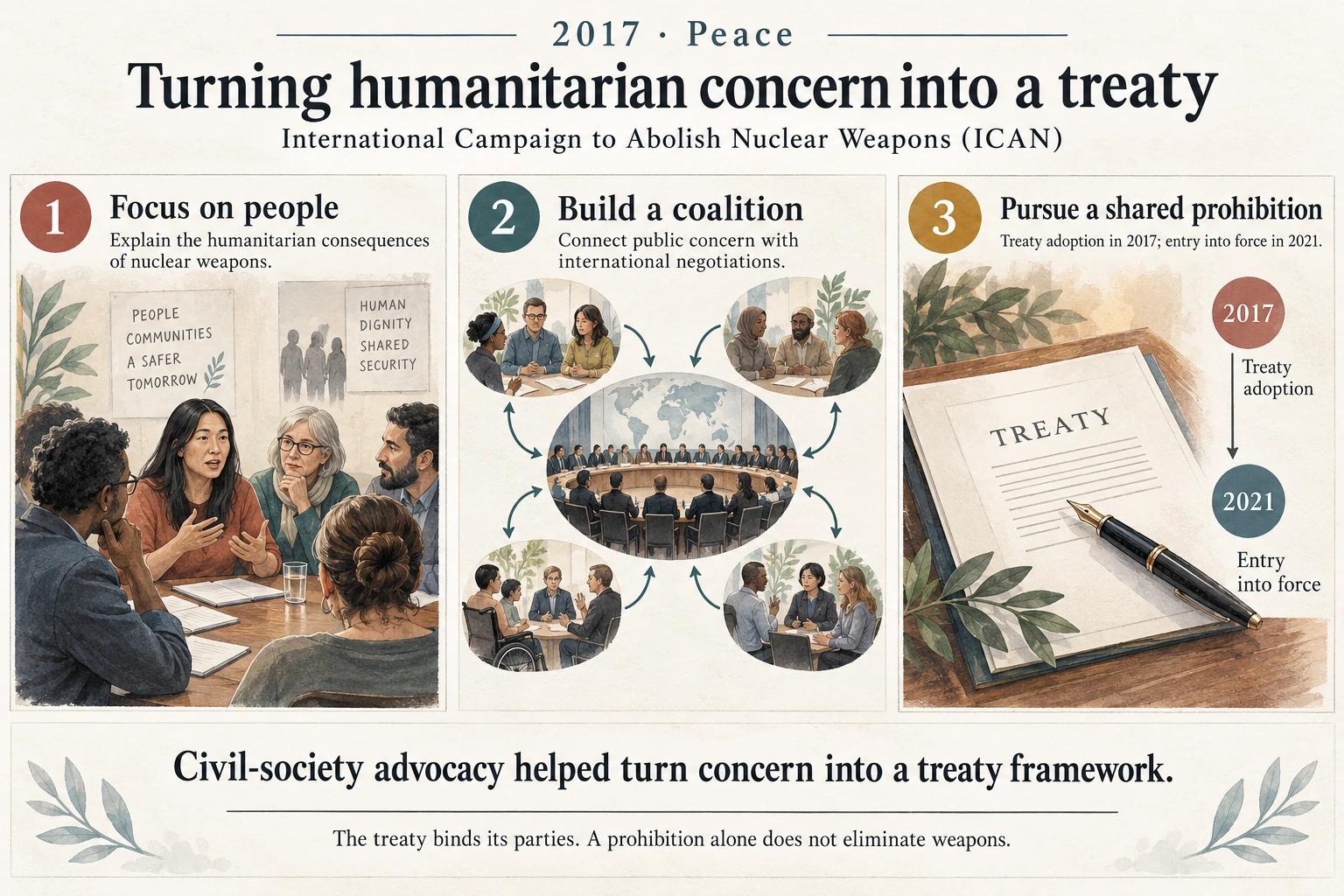
Debates about nuclear weapons often begin with strategy and deterrence. The International Campaign to Abolish Nuclear Weapons asked governments and the public to give central attention to their humanitarian consequences. A nuclear detonation would affect people far beyond military decision-makers. By bringing partner organisations together, supporting public engagement and contributing to international meetings, ICAN worked to turn concern about those consequences into pressure for a legal prohibition.
On 7 July 2017, 122 states voted to adopt the Treaty on the Prohibition of Nuclear Weapons at the United Nations. ICAN was a leading civil-society participant in the process; states negotiated and adopted the treaty. The Nobel Committee recognised the campaign’s contribution while explicitly noting that a prohibition would not by itself eliminate a single weapon. Adoption in 2017 was followed by the treaty’s entry into force on 22 January 2021 for its parties.
Why it matters
The campaign showed how civil-society organisations can influence an international agenda by connecting public concern with negotiations. The treaty created a framework for participating states and strengthened the political argument for prohibition. The contribution is a form of humanitarian advocacy and diplomacy, rather than a scientific invention.