01 · The contribution
The idea, in everyday language
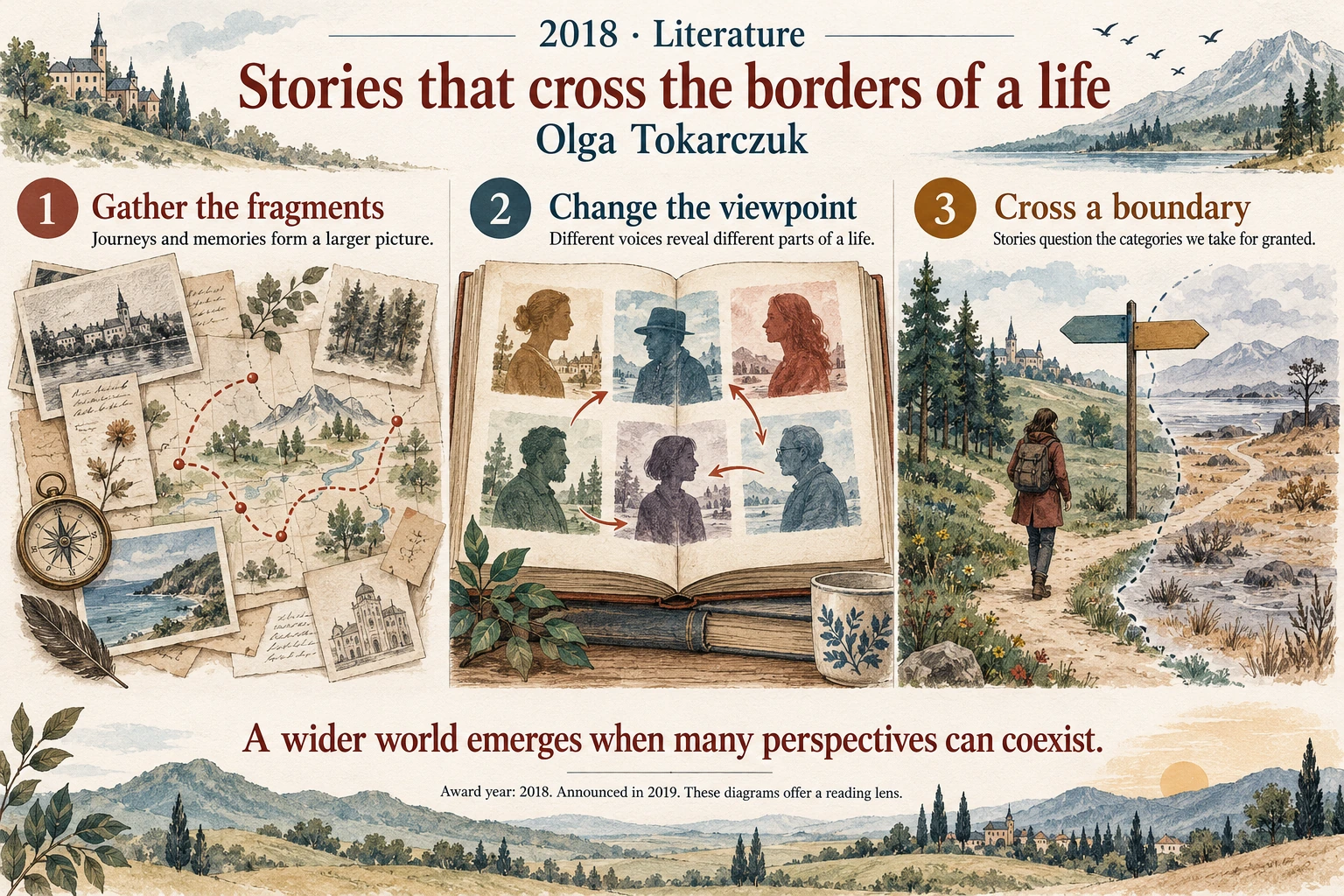
A story need not follow one hero along one straight line. Tokarczuk often builds a larger picture from fragments: a journey, a remembered place, a historical episode or a change of narrator. Flights combines narrative and reflection around movement, bodies and the search for belonging. House of Day, House of Night brings different lives and traditions into a shared landscape. Reading means noticing connections without expecting every piece to resolve into a single simple answer.
Her historical novel The Books of Jacob approaches the eighteenth-century religious leader Jacob Frank through a wide range of surrounding people and perspectives. Archival research supports an imaginative reconstruction, rather than replacing fiction with a textbook. Across these books, borders are geographical but also cultural and mental: between home and elsewhere, inherited categories and unfamiliar lives. The prize recognised this expansive narrative imagination across her writing, not a scientific discovery or one required interpretation.
Why it matters
Her work gives readers ways to encounter lives and histories that do not fit neatly inside national, religious or personal categories. Shifting scale between a small place and a wider world can make an unfamiliar experience imaginable. Translations extend that encounter, with translators making consequential choices about rhythm, voice and cultural references.