c.curionodeThe Nobel Archive

2021 · Economic Sciences

Learning cause and effect from real life

Natural experiments can reveal what a policy changes—if the comparison and its assumptions are credible.

The Sveriges Riksbank Prize in Economic Sciences in Memory of Alfred Nobel.

Natural experimentsCausal inferenceLabour markets
2021Economic Sciences

Visual guide

The prize, pictured

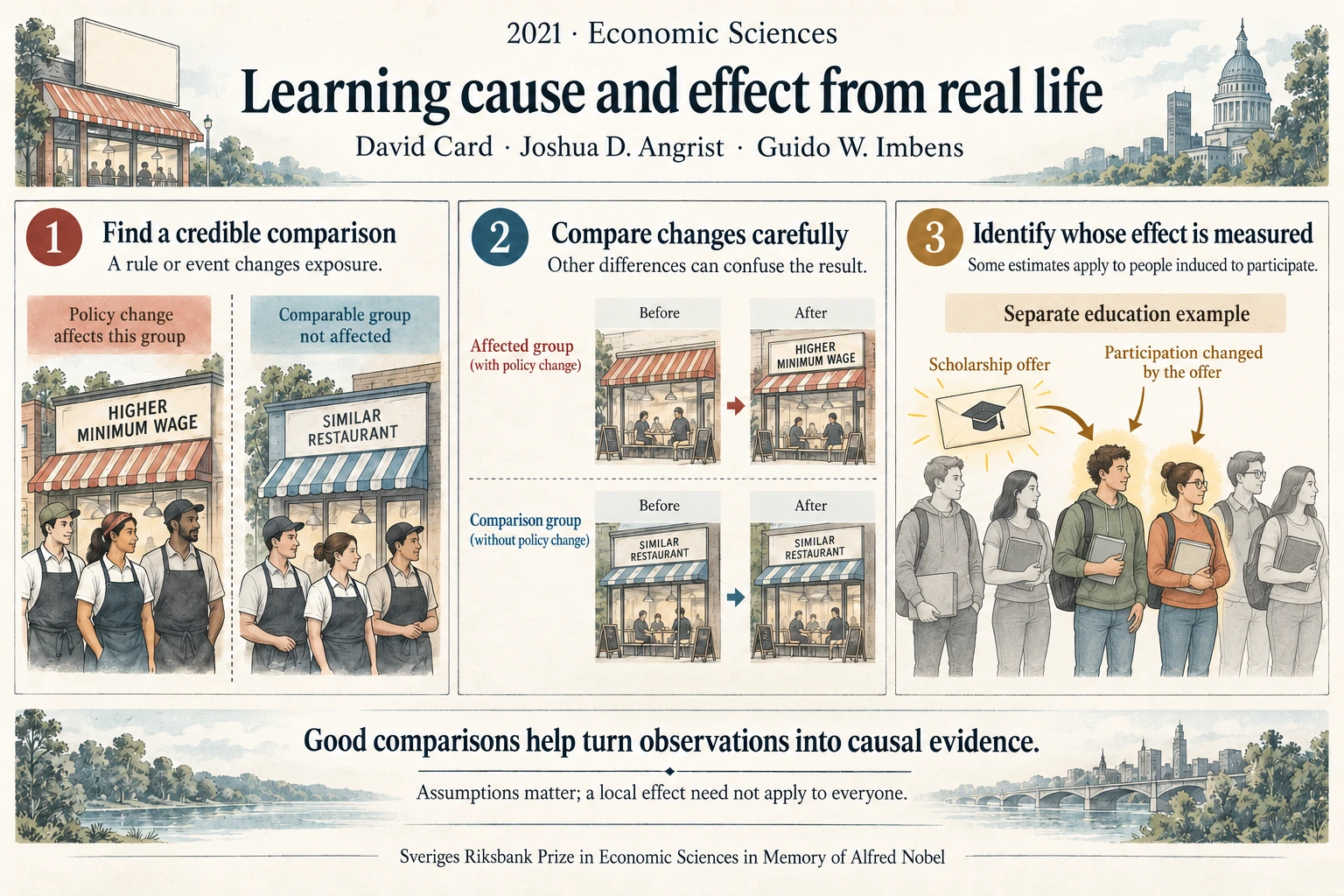
Infographic explaining Learning cause and effect from real life
Original AI-generated infographic. A conceptual overview; the explanations and sources below provide context.
Read the poster text

Good comparisons help turn observations into causal evidence.

  1. Find a credible comparison

    A rule or event changes exposure.

  2. Compare changes carefully

    Other differences can confuse the result.

  3. Identify whose effect is measured

    Some estimates apply to people induced to participate.

Assumptions matter; a local effect need not apply to everyone.

01 · The discovery

The idea, in everyday language

People with more education often earn more, but that alone does not show how much schooling caused their higher earnings. Other differences may matter. Natural experiments use policy rules, chance events or other external changes to create comparisons that can help disentangle causes from correlations.

Card used such comparisons to study wages, immigration and education. Angrist and Imbens clarified what can be learned when an external change encourages some people, but not everyone, to participate. Under specific assumptions, the resulting estimate can describe the effect for people whose decision was changed by that encouragement.

Why it matters

The work reshaped empirical economics by making the research design central to a causal claim. It gave researchers tools for using real-world variation, while requiring them to explain which people and circumstances an estimate actually describes.


02 · The people

Who brought the idea to life?

Illustrated portrait of David Card

David Card

Prize share · 1/2

Using natural experiments, he studied minimum wages, immigration and education. His work with Alan Krueger on fast-food employment challenged the claim that a minimum-wage increase must always reduce jobs, while encouraging closer study of the circumstances in which policies operate.

Read the biography ↗
Illustrated portrait of Joshua D. Angrist

Joshua D. Angrist

Prize share · 1/4

With Imbens, he clarified how an external rule or encouragement can identify an average causal effect for people whose participation it changes. The 1994 framework made the assumptions and the population behind such an estimate explicit.

Read the biography ↗
Illustrated portrait of Guido W. Imbens

Guido W. Imbens

Prize share · 1/4

His joint work with Angrist established the interpretation of local average treatment effects in natural experiments. It explains why an estimate can apply to people induced to participate by a particular rule, rather than automatically to everyone.

Read the biography ↗

03 · Years in the making

The path here

  1. Early 1990s

    Card uses natural experiments to investigate labour-market questions.

  2. 1994

    Card and Krueger publish their comparison of fast-food employment after a minimum-wage change.

  3. 1994

    Imbens and Angrist clarify local average treatment effects.

04 · Read further

From the original sources

Original explanations by Curionode, based on the official records below. Biographical details and affiliations refer to the award year.

  1. Official award announcement nobelprize.org
  2. Nobel Committee’s accessible background nobelprize.org

More in Economic Sciences

Browse this subject ↗