c.curionodeThe Nobel Archive

2022 · Physics

When distant particles share a quantum story

Experiments with entangled light tested the limits of ordinary explanations and opened quantum information science.

EntanglementBell inequalitiesQuantum information
2022Physics

Visual guide

The prize, pictured

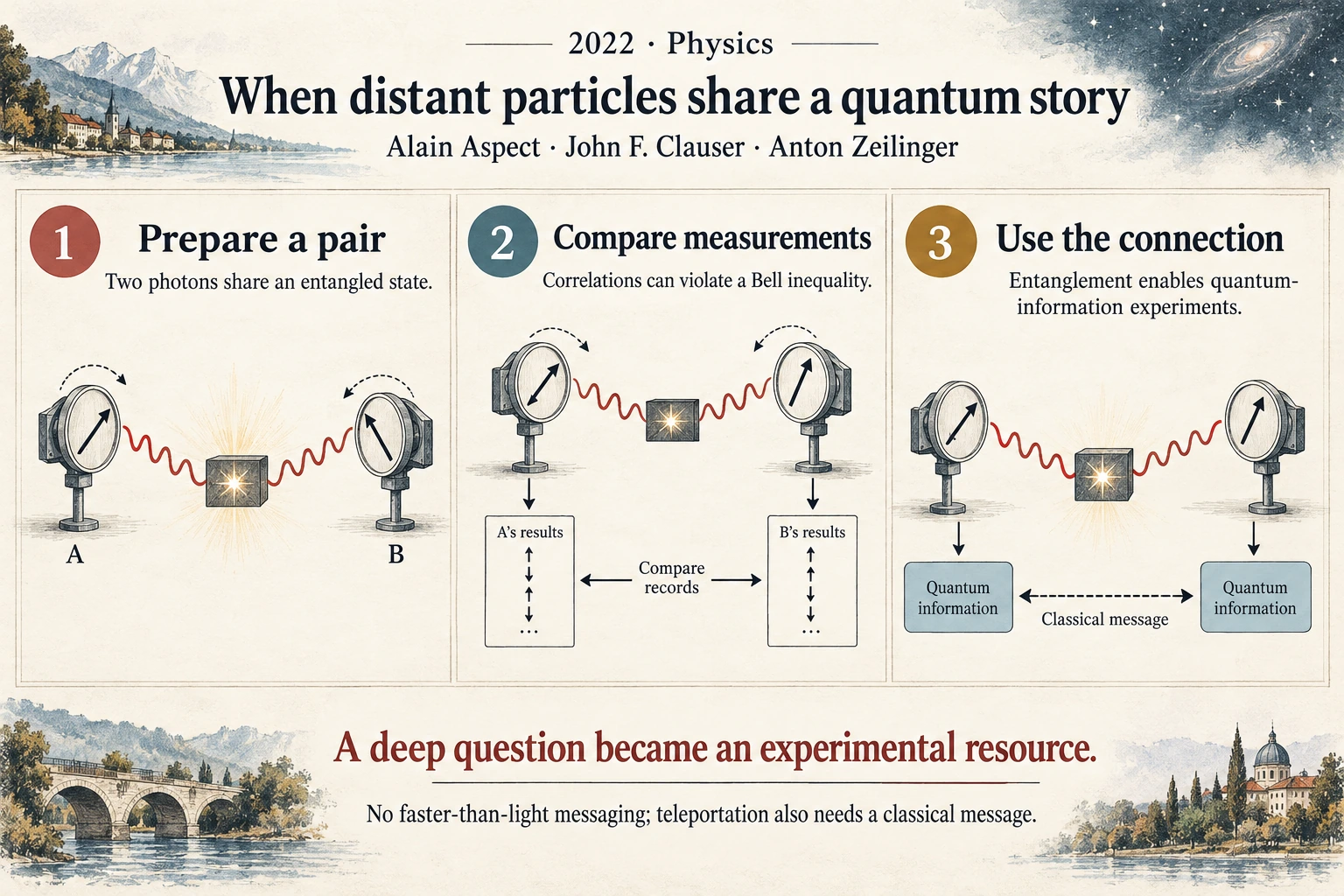
Infographic explaining When distant particles share a quantum story
Original AI-generated infographic. A conceptual overview; the explanations and sources below provide context.
Read the poster text

A deep question became an experimental resource.

  1. Prepare a pair

    Two photons share an entangled state.

  2. Compare measurements

    Correlations can violate a Bell inequality.

  3. Use the connection

    Entanglement enables quantum-information experiments.

No faster-than-light messaging; teleportation also needs a classical message.

01 · The discovery

The idea, in everyday language

An entangled pair is described by a joint quantum state. Measuring the two particles produces correlations that can be stronger than those allowed by a model in which each particle carries a complete set of local, prewritten answers. Bell inequalities make that contrast measurable.

Clauser put the test into practice; Aspect improved it by changing measurement settings during the photons’ flight. Zeilinger developed experiments that used entanglement, including quantum teleportation. The progression turned a foundational question into a resource for new technologies.

Why it matters

Entanglement is central to research on quantum networks, secure communication and computing. These experiments showed that its unusual correlations are physical effects that can be prepared, measured and used.
02 · The people

Who brought the idea to life?

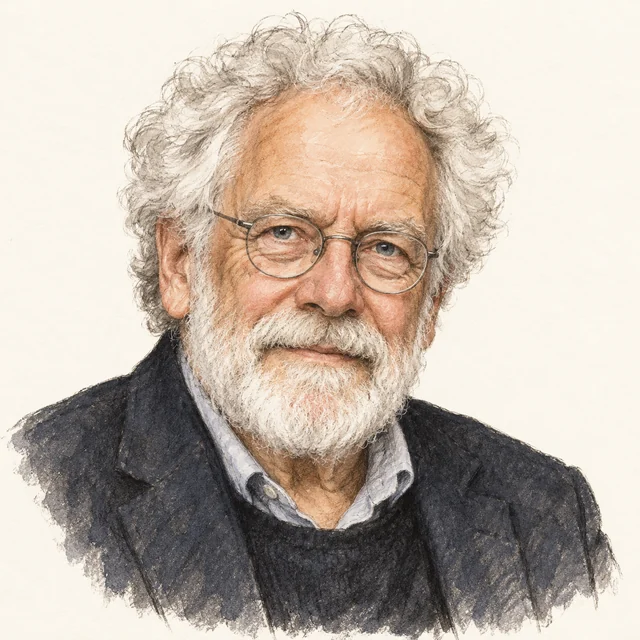
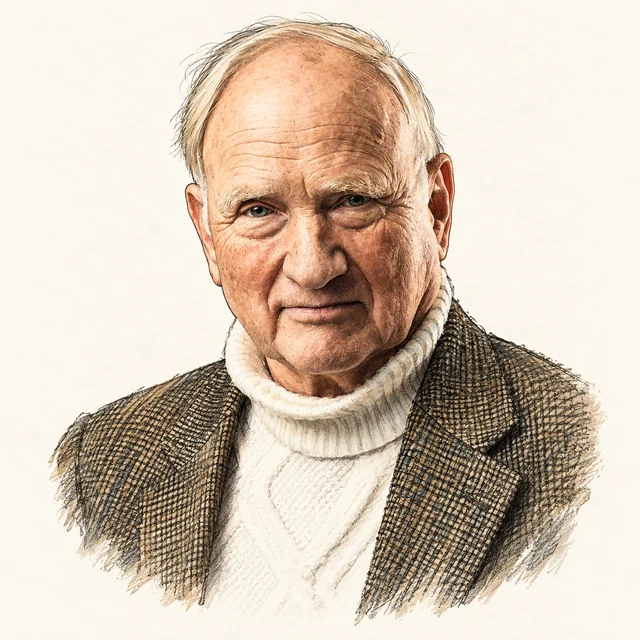
Illustrated portrait of Alain Aspect

Alain Aspect

Prize share · 1/3

In experiments in the early 1980s, he changed the settings of light analysers while photons were travelling through the apparatus. This addressed an important loophole in tests of Bell inequalities and strengthened the evidence for quantum entanglement.

Read the biography ↗
Illustrated portrait of John F. Clauser

John F. Clauser

Prize share · 1/3

With Stuart Freedman, he performed a pioneering 1972 experiment on pairs of photons. Their measured correlations violated a Bell inequality, supporting quantum predictions over the tested local hidden-variable account.

Read the biography ↗
Illustrated portrait of Anton Zeilinger

Anton Zeilinger

Prize share · 1/3

His group demonstrated quantum teleportation in 1997: transferring the state of one photon to another using entanglement and a classical message. His experiments helped establish the possibilities of quantum communication and information processing.

Read the biography ↗

03 · Years in the making

The path here

  1. 1972

    Clauser and Freedman test a Bell inequality with photons.

  2. 1982

    Aspect’s experiments switch analyser settings while photons are in flight.

  3. 1997

    Zeilinger’s group demonstrates quantum teleportation of a photon state.

04 · Read further

From the original sources

Original explanations by Curionode, based on the official records below. Biographical details and affiliations refer to the award year.

  1. Official award announcement nobelprize.org
  2. Nobel Committee’s accessible background nobelprize.org