c.curionodeThe Nobel Archive

2024 · Physics

When a network learns to remember

Ideas from physics became tools for storing patterns and learning from data.

AIPatternsMemory
2024Physics

Visual guide

The prize, pictured

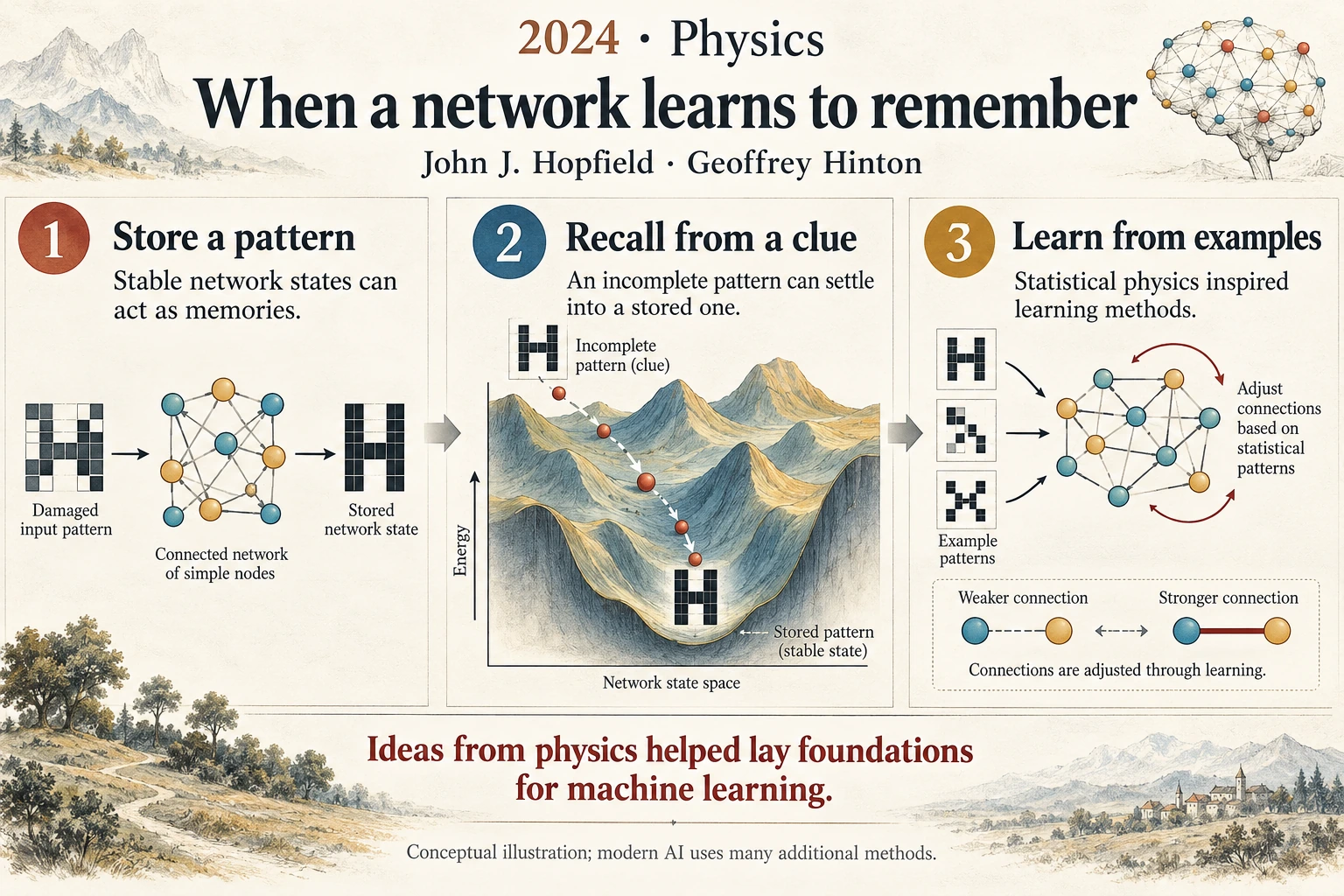
Infographic explaining When a network learns to remember
Original AI-generated infographic. A conceptual overview; the explanations and sources below provide context.
Read the poster text

Ideas from physics helped lay foundations for machine learning.

  1. Store a pattern

    Stable network states can act as memories.

  2. Recall from a clue

    An incomplete pattern can settle into a stored one.

  3. Learn from examples

    Statistical physics inspired learning methods.

Conceptual illustration; modern AI uses many additional methods.

01 · The discovery

The idea, in everyday language

A neural network is a set of connected computational units. Its connections determine how information moves and what patterns the system can recognise. Hopfield showed how a network could store memories as stable collective states.

Hinton used ideas from statistical physics to develop networks that learn the structure of data. These early models helped establish principles behind modern machine learning, though today’s systems are much larger and use many additional techniques.

See the idea

A memory from an imperfect cue

Change how many pixels are obscured.

A simplified nearest-pattern demonstration: compare a damaged letter with two stored patterns. This illustrates associative recall; it is not a simulation of Hopfield dynamics or an AI model.

Why it matters

Learning useful representations from examples became central to image recognition and many other applications of neural networks.
02 · The people

Who brought the idea to life?

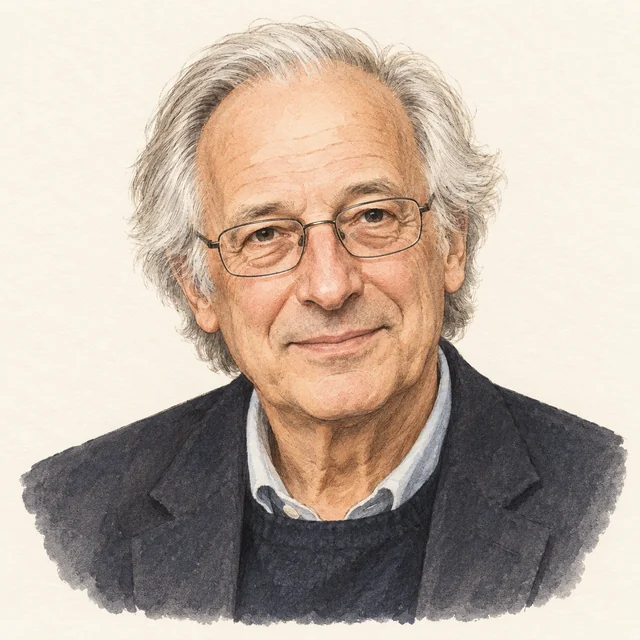
Illustrated portrait of John J. Hopfield

John J. Hopfield

Prize share · 1/2

His 1982 network stores patterns as stable states. Starting from an incomplete or damaged pattern, the network can settle into a stored one, rather as a ball rolls into a valley.

Read the biography ↗
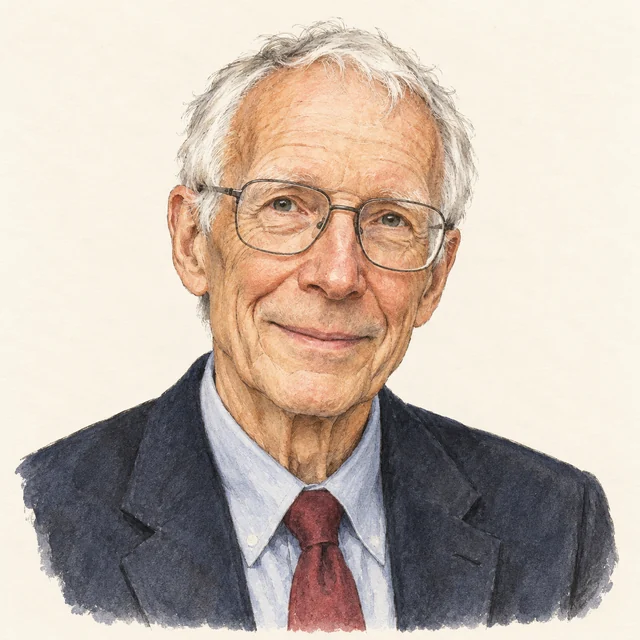
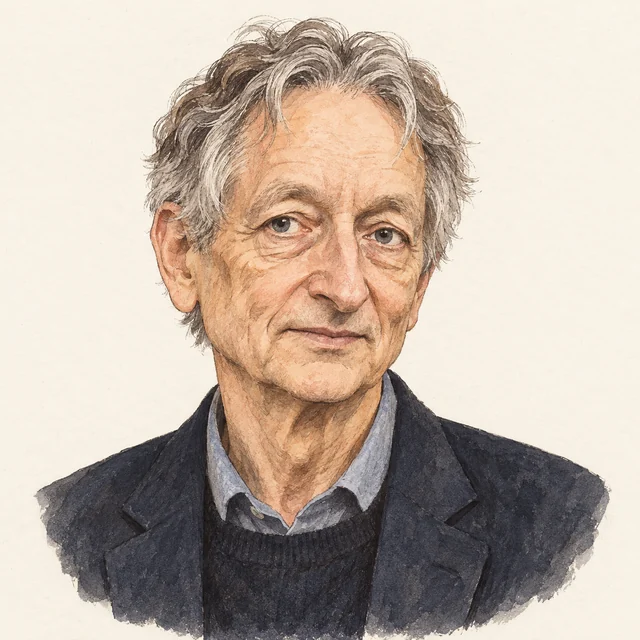
Illustrated portrait of Geoffrey Hinton

Geoffrey Hinton

Prize share · 1/2

Drawing on statistical physics, Hinton and collaborators developed learning methods including the Boltzmann machine. These networks could discover statistical patterns in data, an important foundation for later machine learning.

Read the biography ↗

03 · Years in the making

The path here

  1. 1982

    Hopfield introduces his associative-memory network.

  2. 1980s

    Hinton and collaborators develop statistical learning networks.

  3. 2024

    The Physics prize honours these foundations of machine learning.

04 · Read further

From the original sources

Original explanations by Curionode, based on the official records below. Biographical details and affiliations refer to the award year.

  1. Official award announcement nobelprize.org
  2. Nobel Committee’s accessible background nobelprize.org