01 · The discovery
The idea, in everyday language
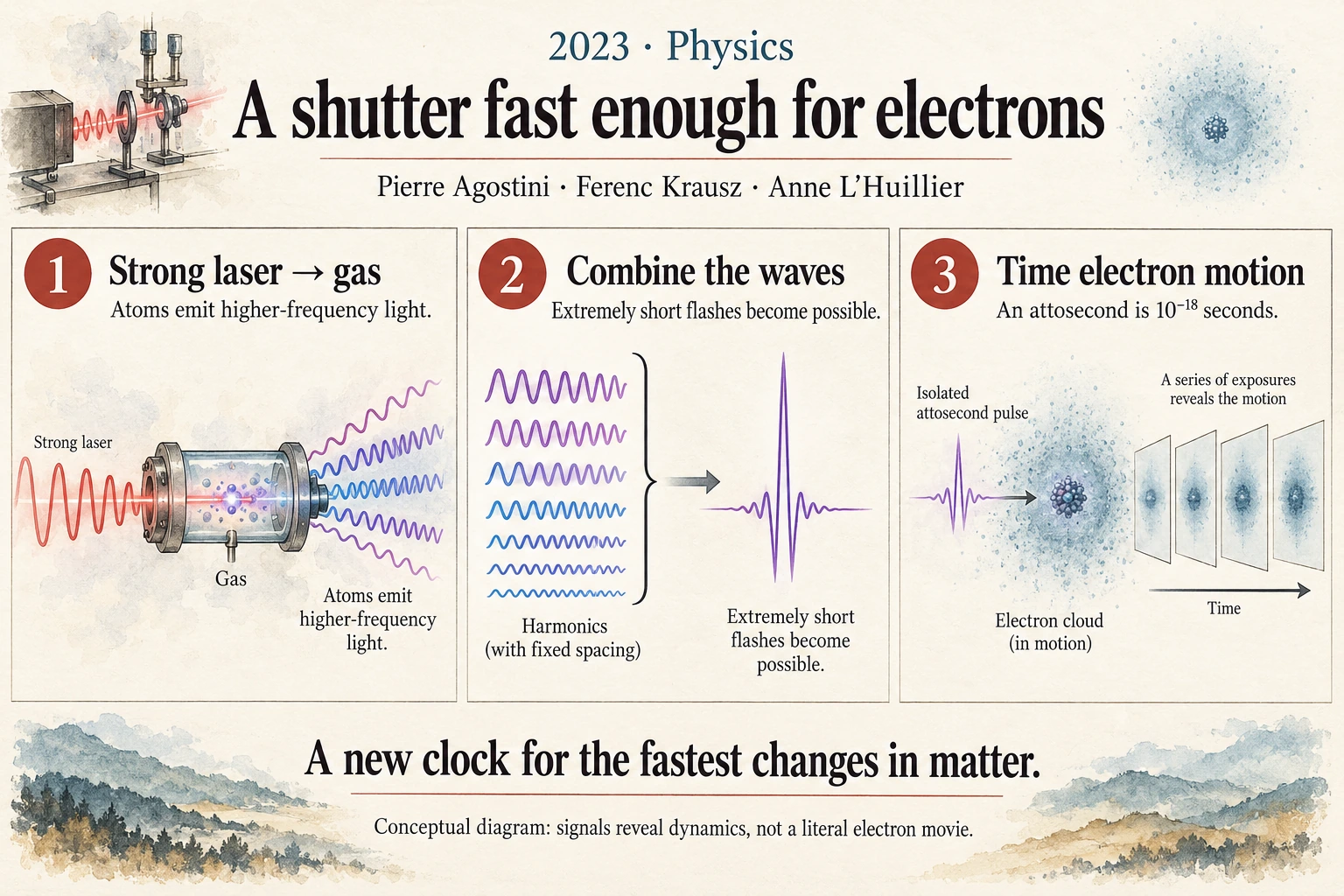
Electrons rearrange far faster than atoms move. To measure that motion, an instrument needs an exceptionally short time window. An attosecond is one quintillionth of a second: 10⁻¹⁸ seconds.
L’Huillier’s work revealed high-frequency light produced when a strong laser meets a gas. Agostini and Krausz then developed ways to create and measure attosecond pulses. These flashes let researchers time changes in electron behaviour rather than seeing only the state before and after.
See the idea
A shorter window reveals more
Change the length of the exposure.
The moving point is an analogy for something changing quickly. Shorter exposures blur less. An electron is not a classical ball, and real attosecond measurements reconstruct dynamics from signals.
Why it matters
Electron motion underlies chemical bonding and the electrical properties of materials. Resolving its timing gives researchers new tools for investigating both.