A life in context
The person behind the prize
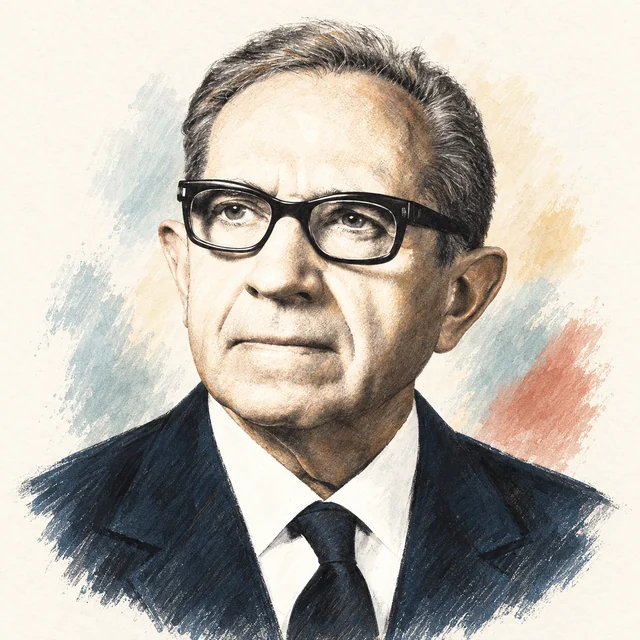
Claude grew up in the Belgian Ardennes with limited access to formal schooling. His autobiography recalls an early fascination with a chemistry illustration and the disruptions of war. He obtained a medical degree at Liège in 1928, trained in Berlin and joined the Rockefeller Institute in 1929. By breaking cells open and separating their components with centrifugation, he made it possible to study particular fractions biochemically. Work with the electron microscope provided another way to connect structure with function. He returned to Belgium in 1949 to direct the Jules Bordet Institute, later working at Louvain. The birth year used here follows his autobiography and the obituary by de Duve and Palade; the official facts page gives a different year. His methods helped establish cell biology as an experimental discipline.
The contribution
Claude developed cell-fractionation methods and pioneering biological electron microscopy, connecting cellular structure with biochemical study. He received one third of the Medicine Prize.
The idea in plain language
Claude developed cell fractionation: cells are disrupted and their components separated through centrifugation, producing fractions that can be examined chemically. Sedimentation depends on size, density and shape, so a fraction is not automatically one pure organelle. Electron microscopy provided detailed structural information. Comparing the chemistry of fractions with their microscopic appearance helped connect components with particular cellular activities.
Read the full award story ↗