A life in context
The person behind the prize
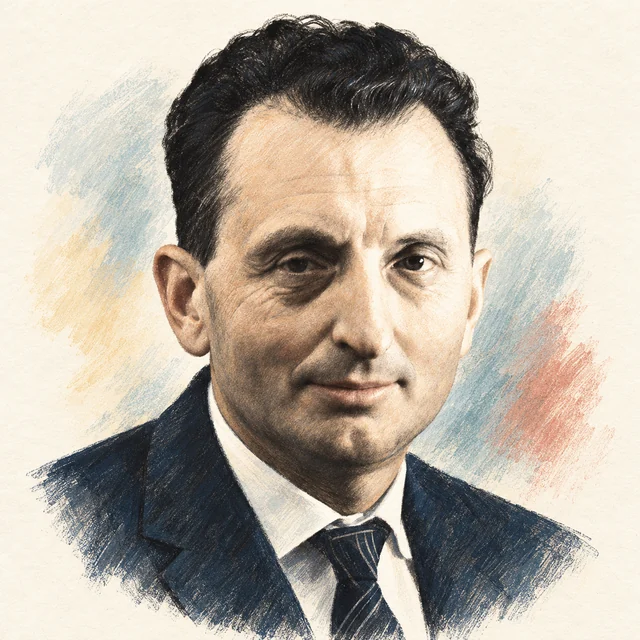
Prokhorov was born in Australia and moved with his parents to the Soviet Union in 1923. He entered Leningrad University in 1934, graduated in 1939 and began postgraduate work at Lebedev in Moscow. Military service interrupted research in 1941; after being wounded, he returned to the laboratory in 1944. He defended a frequency-stabilisation thesis in 1946 and a further thesis on coherent synchrotron radiation in 1951. As assistant laboratory head from 1950, then head from 1954, he developed microwave spectroscopy and quantum electronics. With Basov he investigated molecular oscillators and proposed a pumping method in 1955. Work with collaborators on paramagnetic resonance and resonators contributed to masers and lasers, including an open-cavity proposal in 1958. Lebedev was his 1964 affiliation; he received a quarter share of the prize.
The contribution
Prokhorov developed molecular-oscillator, pumping and resonator ideas with Basov and other collaborators. He received one quarter of the Physics Prize.
The idea in plain language
Radiation can stimulate an excited atom or molecule to emit matching radiation. Under ordinary conditions absorption can dominate. Amplification requires suitable preparation, including more particles in the upper than the lower state of the relevant transition: a population inversion.
Read the full award story ↗