A life in context
The person behind the prize
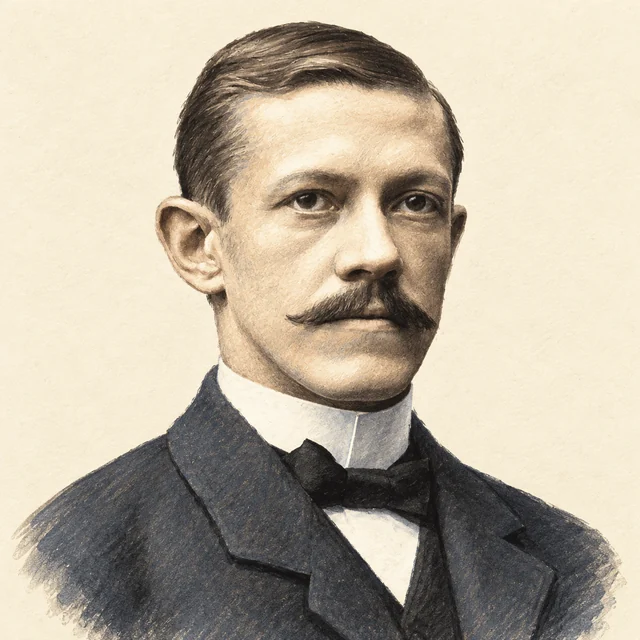
Allvar Gullstrand studied medicine in Uppsala, Vienna and Stockholm, qualifying in 1888 and defending a thesis on astigmatism in 1890. Clinical questions led him towards mathematics: existing optical formulas could not fully describe an eye whose lens changes shape and whose refractive index varies internally. He became a lecturer in ophthalmology in 1891 and Uppsala’s first professor of the subject in 1894. His research developed more general ways to analyse image formation, then applied them to the cornea, lens and accommodation of the eye. The full 1911 Physiology or Medicine Prize recognised this work on its dioptrics, meaning its light-refracting properties. He also developed examination instruments, including the slit lamp and reflection-free ophthalmoscope, and worked with the optical firm Carl Zeiss. These connected theoretical models with the practical observation of the eye. In 1914 a personal chair in physical and physiological optics allowed him to concentrate on research; he became emeritus in 1927 and died in Stockholm in 1930. As a member of the Physics Nobel Committee, he opposed a prize for Einstein’s relativity, a later institutional controversy separate from his own award. Optical image formation is one part of seeing, not a complete account of the retina, nervous system or visual experience.
The contribution
Gullstrand received the full Medicine Prize for work on the eye’s dioptrics. He treated its layered, changing lens as a complex optical system and developed mathematical tools for understanding refraction and image formation.
The idea in plain language
A simple lens calculation can assume one uniform material and fixed surfaces. The eye is harder: light crosses the cornea and internal media, while the crystalline lens has a refractive index that varies from layer to layer. Its shape also changes during accommodation, allowing near and distant objects to be brought into focus. Gullstrand developed optical analysis suited to such complex systems and used it to study the eye’s image formation.
Read the full award story ↗

