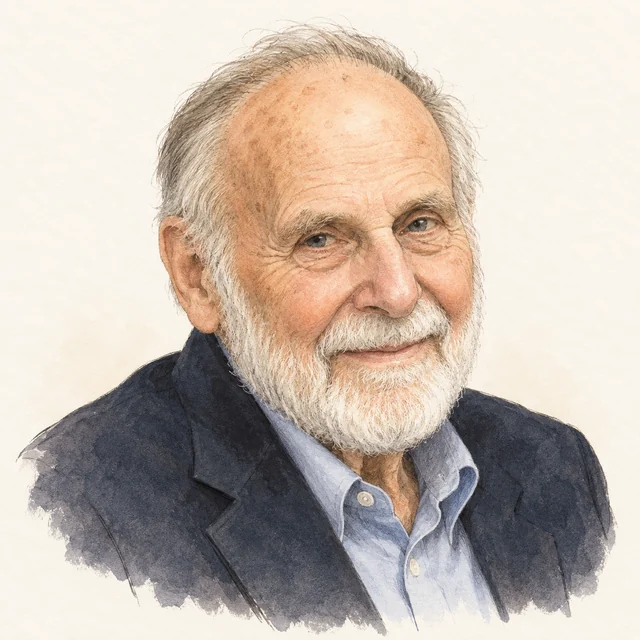
A life in context
The person behind the prize
Ashkin studied physics at Columbia University and earned his doctorate at Cornell in 1952. At Bell Laboratories he explored a deceptively simple question: could light move matter as well as illuminate it? His experiments with tiny transparent particles grew into a way of holding microscopic objects without mechanical jaws. That tool connected laser physics with the study of living cells and molecular machinery.
The contribution
He developed optical tweezers, which use the forces from a tightly focused laser beam to trap small objects. In 1987 he demonstrated trapping of living bacteria without harming them under suitable illumination, opening a route to biological measurements.
The idea in plain language
Light carries momentum, so it can exert a force when its direction changes. Arthur Ashkin found that a tightly focused laser could hold a tiny transparent object near its focus. The object is pulled towards the region of stronger light while other light forces push along the beam; a suitable arrangement creates a stable trap. These optical tweezers let researchers manipulate small objects and measure very small forces. Biological use requires appropriate wavelengths and powers: a laser that traps an object can also damage it.
Read the full award story ↗