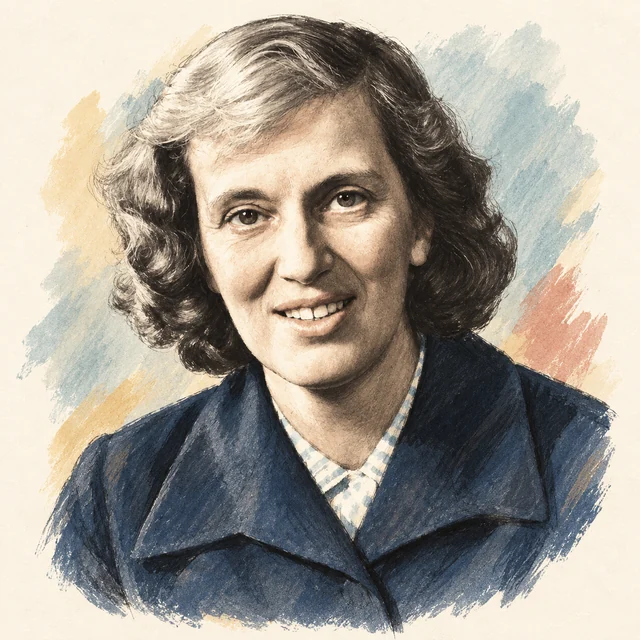
A life in context
The person behind the prize
Hodgkin became interested in chemistry and crystals as a child. She studied at Oxford’s Somerville College from 1928 to 1932 and then worked with J. D. Bernal at Cambridge. Returning to Oxford in 1934, she combined research with teaching chemistry at the women’s colleges. She became lecturer in 1946, Reader in X-ray Crystallography in 1956 and Royal Society Wolfson Research Professor in 1960. Her groups used diffraction measurements, calculation and chemical reasoning to solve demanding structures. Oxford’s museum dates the elucidation of penicillin to 1945; the Nobel account gives 1946. An international team reported vitamin B12 structural work in 1955, before further publication in 1956. The 1964 prize recognised important biochemical structures. Early work on insulin does not mean its complete structure was already solved at the award date.
The contribution
Hodgkin determined structures of important biochemical substances using X-ray techniques. She received the full Chemistry Prize.
The idea in plain language
A complex substance’s chemical behaviour does not always reveal how its atoms are arranged. X-rays scattered by a crystal produce a pattern related to that arrangement, but the pattern is not a direct photograph of a molecule.
Read the full award story ↗

