c.curionodeThe Nobel Archive

1964 · Chemistry

Inferring complex structures from X-ray diffraction

Hodgkin combined diffraction experiments, calculation and chemical reasoning to determine important biochemical structures.

X-ray diffractionStructural inferenceBiochemical substances
1964Chemistry

Visual guide

The prize, pictured

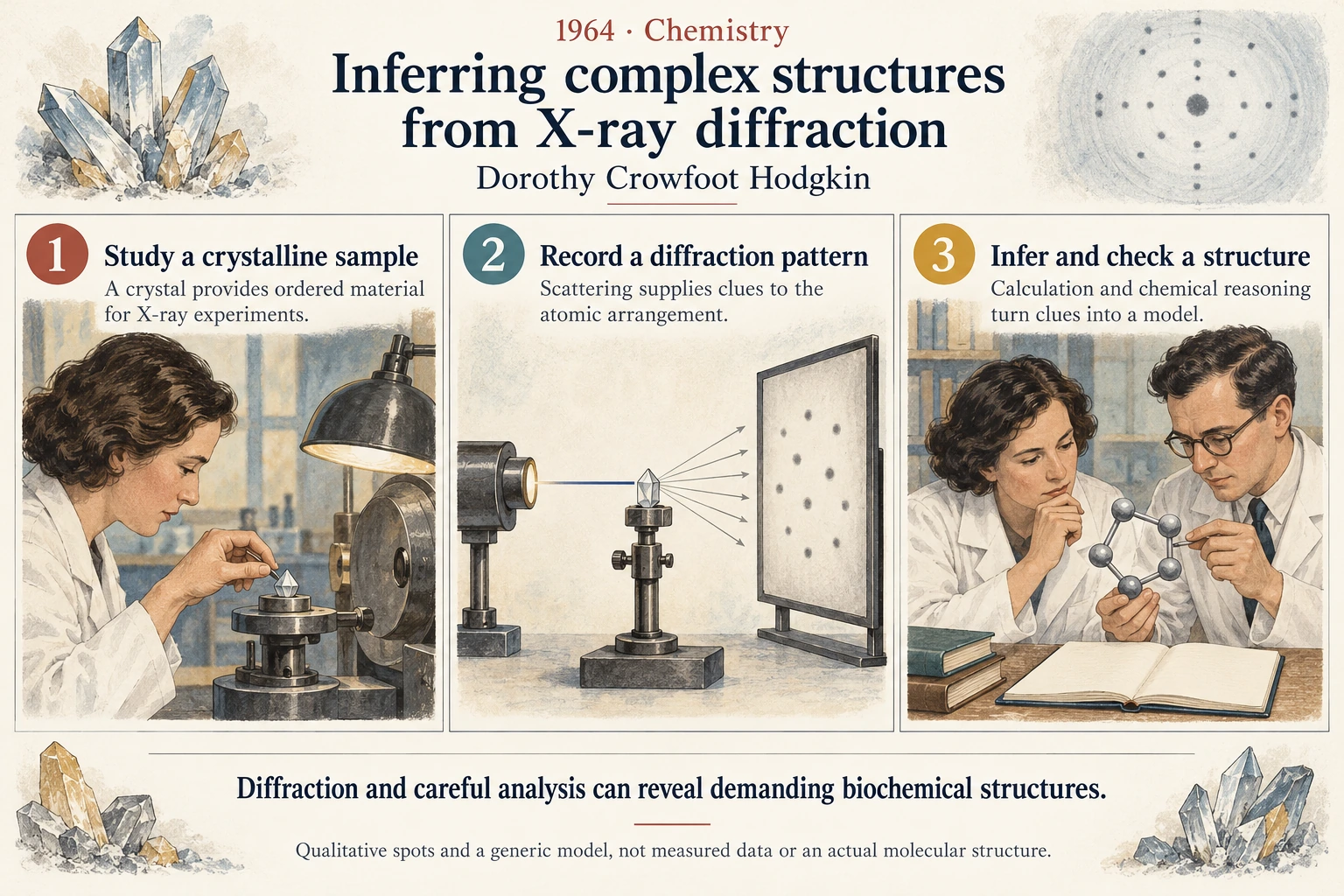
Infographic explaining Inferring complex structures from X-ray diffraction
Original AI-generated infographic. A conceptual overview; the explanations and sources below provide context.
Read the poster text

Diffraction and careful analysis can reveal demanding biochemical structures.

  1. Study a crystalline sample

    A crystal provides ordered material for X-ray experiments.

  2. Record a diffraction pattern

    Scattering supplies clues to the atomic arrangement.

  3. Infer and check a structure

    Calculation and chemical reasoning turn clues into a model.

Qualitative spots and a generic model, not measured data or an actual molecular structure.

01 · The discovery

The idea, in everyday language

A complex substance’s chemical behaviour does not always reveal how its atoms are arranged. X-rays scattered by a crystal produce a pattern related to that arrangement, but the pattern is not a direct photograph of a molecule.

Hodgkin and collaborators amassed measurements and used mathematical analysis, electron-density maps and structural reasoning. Penicillin and vitamin B12 were especially important achievements. Oxford’s museum dates penicillin’s elucidation to 1945, while the Nobel account gives 1946. A multinational team published B12 structural work in 1955, followed by further reporting in 1956.

Why it matters

The work expanded crystallography’s reach into demanding biochemical molecules and supplied knowledge needed to understand properties and plan further chemistry. Hodgkin received the full prize, while the research relied on students, collaborators and advances in calculation. Structure determination did not automatically supply a complete synthesis.
02 · The people

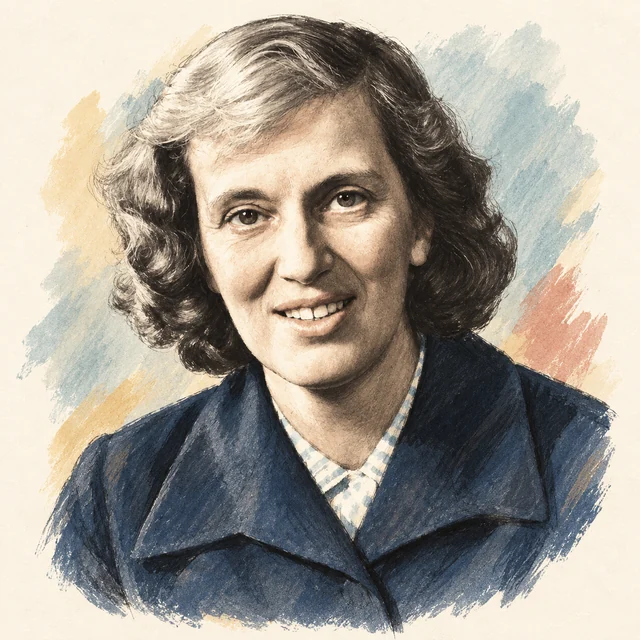
Who brought the idea to life?

03 · Years in the making

The path here

  1. 1934

    Hodgkin returns to Oxford from Bernal’s Cambridge group.

  2. 1945

    Oxford’s museum dates the penicillin structure breakthrough to this year.

  3. 1948

    Research on vitamin B12 begins.

  4. 1955

    The international team publishes B12 structural work.

  5. 1956

    Further B12 structural reporting appears.

  6. 1960

    Hodgkin becomes Royal Society Wolfson Research Professor.

  7. 1964

    She receives the Chemistry Prize.

04 · Read further

From the original sources

Original explanations by Curionode, based on the official records below. Biographical details and affiliations refer to the award year.

  1. Official award summary nobelprize.org
  2. Award ceremony speech nobelprize.org
  3. Oxford penicillin structure exhibit mhs.ox.ac.uk
  4. Vitamin B12 original publication metadata (1955) nature.com
  5. Vitamin B12 original publication metadata (1956) nature.com
  6. Official biography: Dorothy Crowfoot Hodgkin nobelprize.org

More in Chemistry

Browse this subject ↗