c.curionodeThe Nobel Archive

1966 · Chemistry

Describing electrons across a molecule

Mulliken’s molecular-orbital method explained chemical bonds and electronic structure by treating the molecule as a quantum system.

Molecular orbitalsChemical bondsElectronic structure
1966Chemistry

Visual guide

The prize, pictured

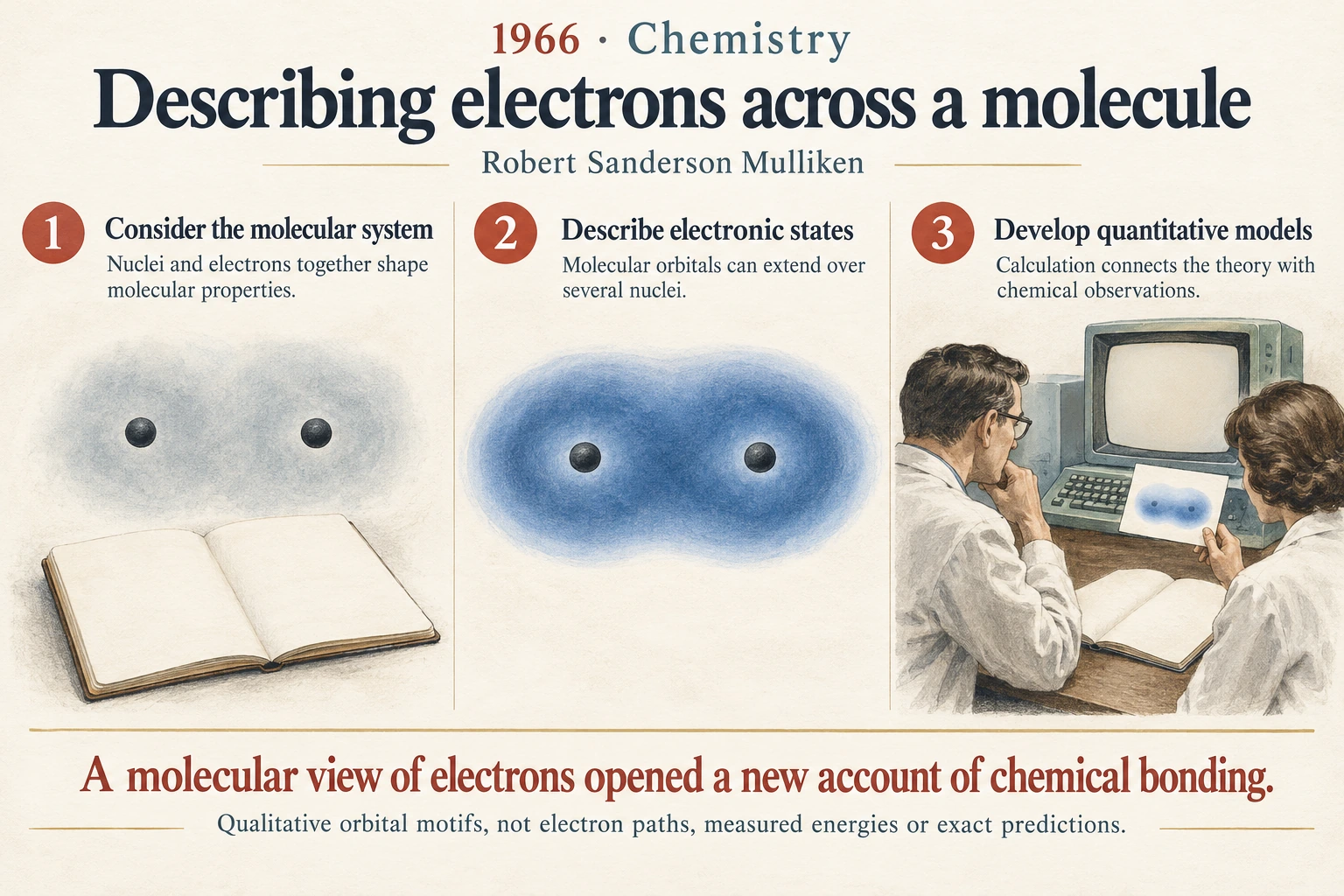
Infographic explaining Describing electrons across a molecule
Original AI-generated infographic. A conceptual overview; the explanations and sources below provide context.
Read the poster text

A molecular view of electrons opened a new account of chemical bonding.

  1. Consider the molecular system

    Nuclei and electrons together shape molecular properties.

  2. Describe electronic states

    Molecular orbitals can extend over several nuclei.

  3. Develop quantitative models

    Calculation connects the theory with chemical observations.

Qualitative orbital motifs, not electron paths, measured energies or exact predictions.

01 · The discovery

The idea, in everyday language

A molecule’s properties depend on its nuclei and electrons together. Mulliken helped develop a way to describe electronic states in the effective field of the molecule, rather than relying only on a picture of intact atoms linked by separate electron pairs.

A molecular orbital is a one-electron wavefunction within a model of the molecular system. It may extend over several nuclei. The available orbitals, their energies and occupation help explain bonding and spectra. Mulliken, Hund and other researchers developed the approach, and Chicago collaborators advanced quantitative calculations.

Why it matters

The method linked physical laws with chemical understanding and supplied a framework for interpreting bonds, spectra and reactions. Electronic computation expanded quantitative applications. The prize recognised fundamental molecular-orbital work, rather than a claim that every chemical problem had become exactly predictable.

02 · The people

Who brought the idea to life?

03 · Years in the making

The path here

  1. 1917

    Mulliken graduates from MIT.

  2. 1921

    He completes his Chicago doctorate.

  3. 1925

    He develops early molecular electronic-structure ideas.

  4. 1928

    He joins the University of Chicago.

  5. 1931

    He becomes professor of physics.

  6. 1966

    He receives the Chemistry Prize.

04 · Read further

From the original sources

Original explanations by Curionode, based on the official records below. Biographical details and affiliations refer to the award year.

  1. Official award summary nobelprize.org
  2. Award ceremony speech nobelprize.org
  3. IUPAC molecular orbital definition goldbook.iupac.org
  4. Official biography: Robert Sanderson Mulliken nobelprize.org

More in Chemistry

Browse this subject ↗