c.curionodeThe Nobel Archive

1968 · Chemistry

Relationships within irreversible transport

Heat flow, diffusion and other transport processes can influence one another. Onsager discovered relations among their response coefficients.

Irreversible processesReciprocal relationsLinear response
1968Chemistry

Visual guide

The prize, pictured

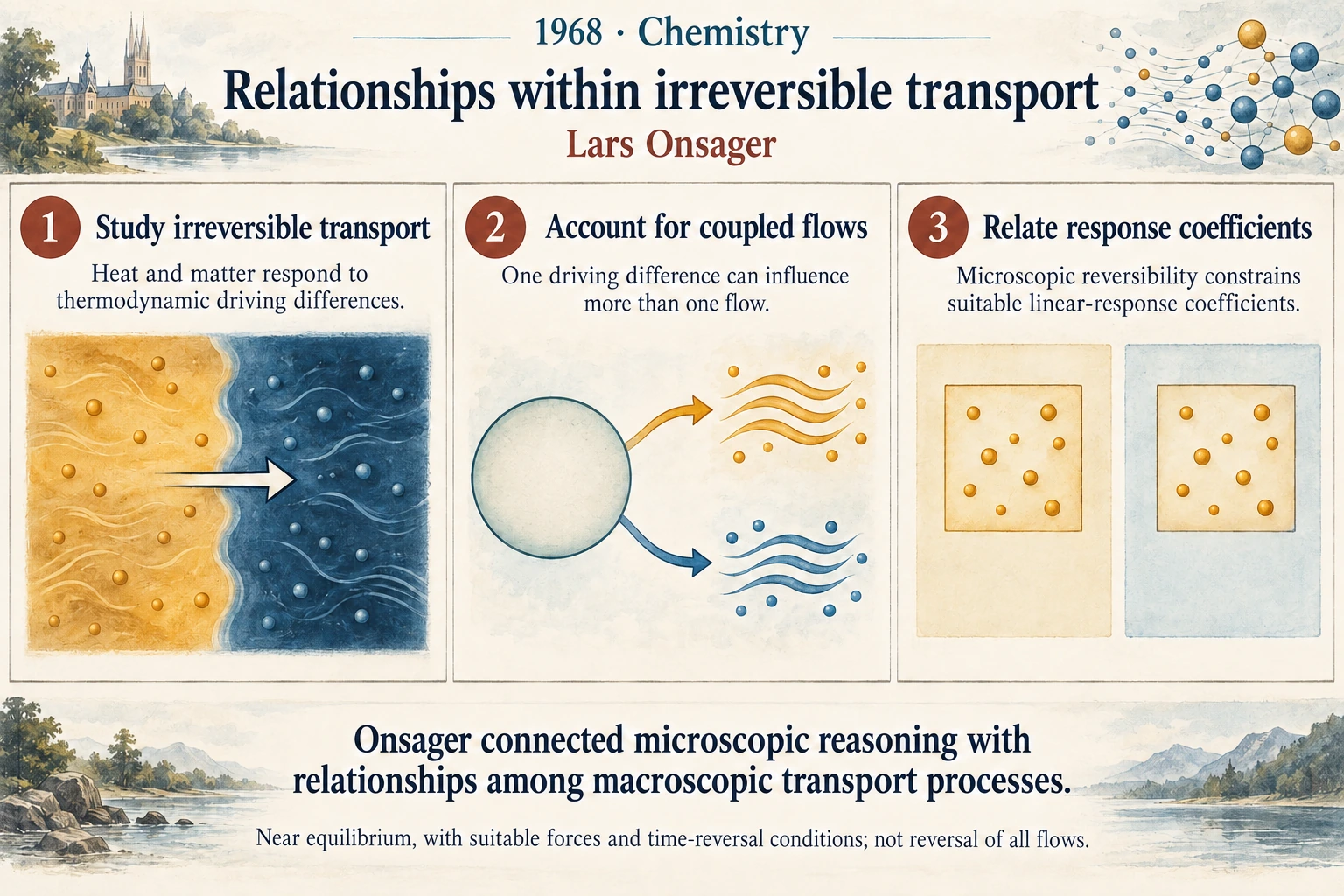
Infographic explaining Relationships within irreversible transport
Original AI-generated infographic. A conceptual overview; the explanations and sources below provide context.
Read the poster text

Onsager connected microscopic reasoning with relationships among macroscopic transport processes.

  1. Study irreversible transport

    Heat and matter respond to thermodynamic driving differences.

  2. Account for coupled flows

    One driving difference can influence more than one flow.

  3. Relate response coefficients

    Microscopic reversibility constrains suitable linear-response coefficients.

Near equilibrium, with suitable forces and time-reversal conditions; not reversal of all flows.

01 · The discovery

The idea, in everyday language

Irreversible transport carries a system toward equilibrium, as with heat flowing from warmer to cooler regions. When processes are coupled, one thermodynamic driving difference can influence more than one flow.

Onsager related suitably defined linear-response coefficients using microscopic reversibility and statistical fluctuations. The reciprocity concerns how one process responds to another process’s driving force, rather than a claim that every physical flow is equal or runs backwards.

Why it matters

The relations gave irreversible thermodynamics a powerful organising principle, connecting microscopic statistical reasoning with macroscopic transport. They supported analysis across physical chemistry and related fields.
02 · The people

Who brought the idea to life?

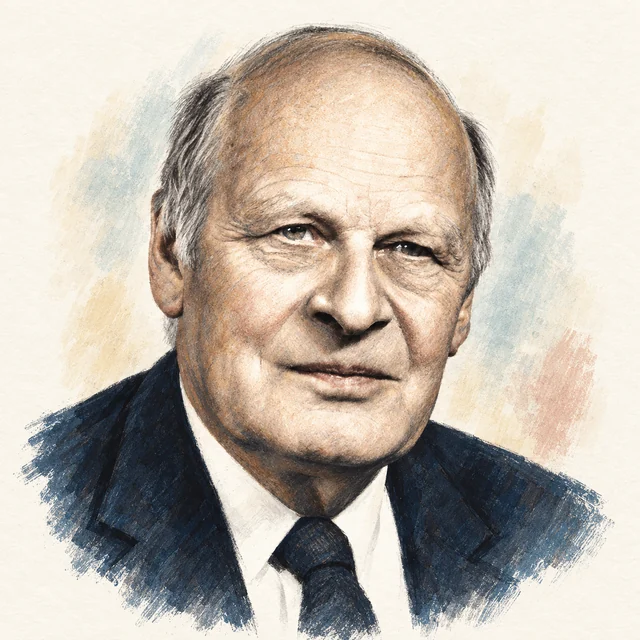
Illustrated portrait of Lars Onsager

Lars Onsager

Prize share · 1

Onsager discovered reciprocal relations fundamental to the thermodynamics of irreversible processes. He received the full Chemistry Prize.

Read the biography ↗

03 · Years in the making

The path here

  1. 1925

    Onsager graduates in chemical engineering.

  2. 1929

    He presents his reciprocal-relations work.

  3. 1931

    Two fundamental papers are published.

  4. 1933

    He joins Yale.

  5. 1945

    He becomes Gibbs Professor of Theoretical Chemistry.

  6. 1968

    He receives the Chemistry Prize.

04 · Read further

From the original sources

Original explanations by Curionode, based on the official records below. Biographical details and affiliations refer to the award year.

  1. Official award summary nobelprize.org
  2. Award ceremony speech nobelprize.org
  3. Onsager original abstract (1931) journals.aps.org
  4. Official biography: Lars Onsager nobelprize.org

More in Chemistry

Browse this subject ↗