c.curionodeThe Nobel Archive

1970 · Chemistry

Activated sugar donors make biosynthesis understandable

How does a cell assemble carbohydrates? Leloir identified sugar nucleotides and showed how they participate in building and transforming carbohydrate molecules.

Sugar nucleotidesBiosynthesisCarbohydrate metabolism
1970Chemistry

Visual guide

The prize, pictured

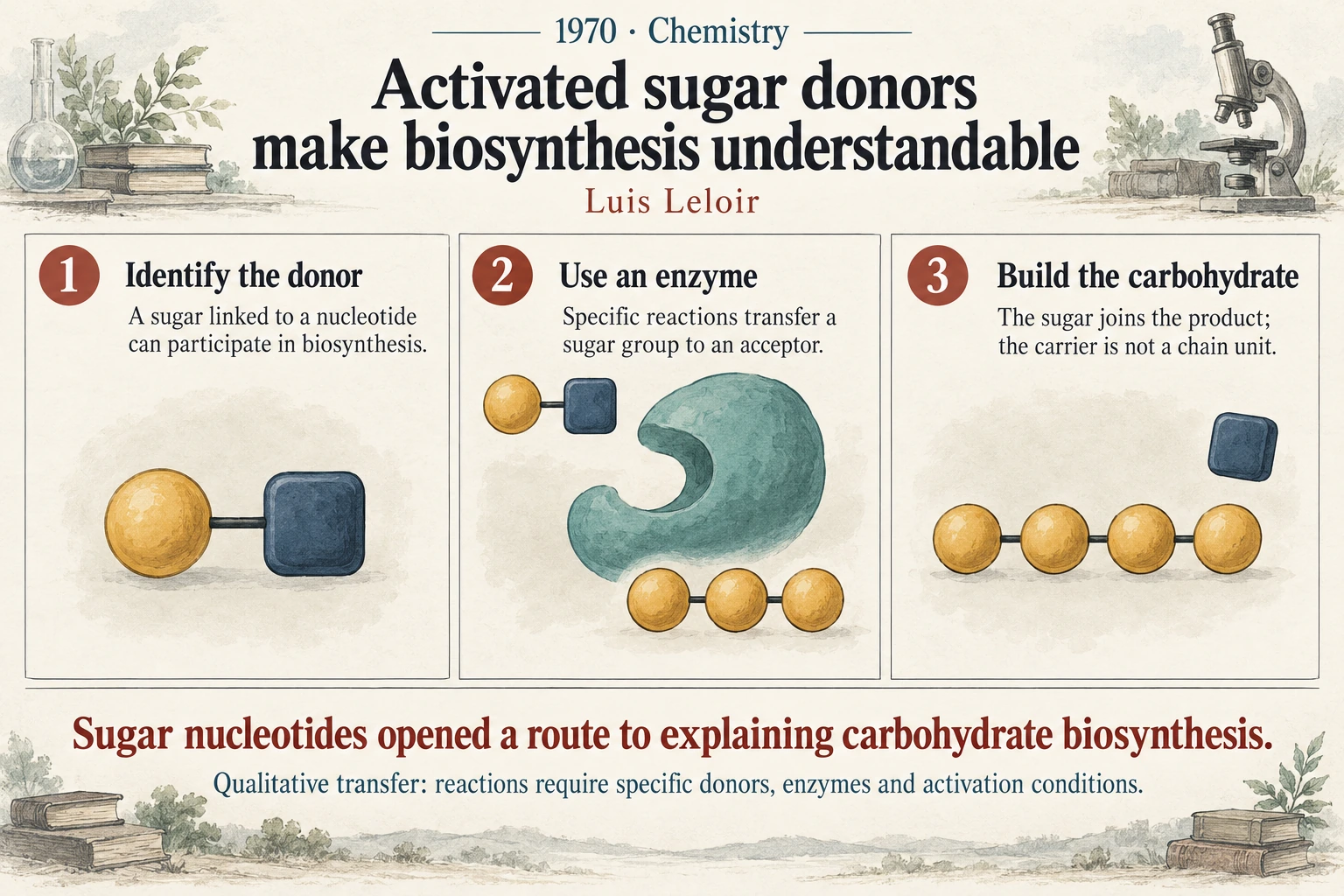
Infographic explaining Activated sugar donors make biosynthesis understandable
Original AI-generated infographic. A conceptual overview; the explanations and sources below provide context.
Read the poster text

Sugar nucleotides opened a route to explaining carbohydrate biosynthesis.

  1. Identify the donor

    A sugar linked to a nucleotide can participate in biosynthesis.

  2. Use an enzyme

    Specific reactions transfer a sugar group to an acceptor.

  3. Build the carbohydrate

    The sugar joins the product; the carrier is not a chain unit.

Qualitative transfer: reactions require specific donors, enzymes and activation conditions.

01 · The discovery

The idea, in everyday language

Investigations of galactose metabolism revealed that a sugar’s conversion depended on an additional compound. Leloir and colleagues identified nucleotide-linked sugars, including UDP-glucose. Linking the sugar to a nucleotide created a chemically useful donor form that enzymes could recognise and use.

Further work showed how sugar groups could be transferred from these donors to accepting molecules. Studies connected sugar nucleotides with the formation of trehalose, sucrose and polysaccharides such as glycogen. The nucleotide portion is not added as a repeat unit of the carbohydrate chain. Synthesis could follow routes distinct from simply reversing breakdown.

Why it matters

The work opened a broad route into carbohydrate biosynthesis and stimulated investigations of many different nucleotide sugars. It connected chemical identification with metabolic function, helping explain how cells form complex carbohydrate-containing materials.
02 · The people

Who brought the idea to life?

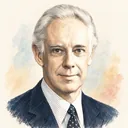
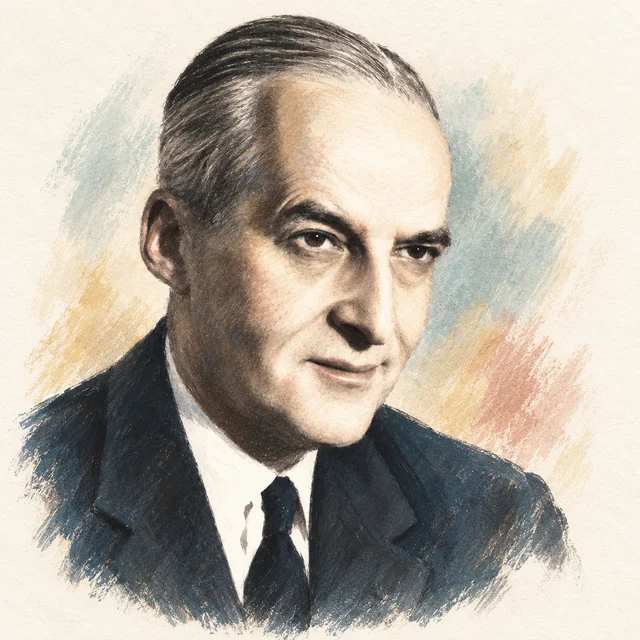
Illustrated portrait of Luis Leloir

Luis Leloir

Prize share · 1

Leloir discovered sugar nucleotides and established their roles in carbohydrate biosynthesis. He received the entire Chemistry Prize.

Read the biography ↗

03 · Years in the making

The path here

  1. 1932

    Leloir completes his Buenos Aires medical degree.

  2. 1936

    He works at Cambridge’s biochemical laboratory.

  3. 1949

    He publishes the foundational sugar-nucleotide discovery.

  4. 1953

    Work with Cabib connects UDP-glucose with trehalose synthesis.

  5. 1955

    Work with colleagues connects it with sucrose synthesis.

  6. 1970

    He receives the Chemistry Prize.

04 · Read further

From the original sources

Original explanations by Curionode, based on the official records below. Biographical details and affiliations refer to the award year.

  1. Official award summary nobelprize.org
  2. Award ceremony speech nobelprize.org
  3. Official biography: Luis Leloir nobelprize.org

More in Chemistry

Browse this subject ↗