01 · The discovery
The idea, in everyday language
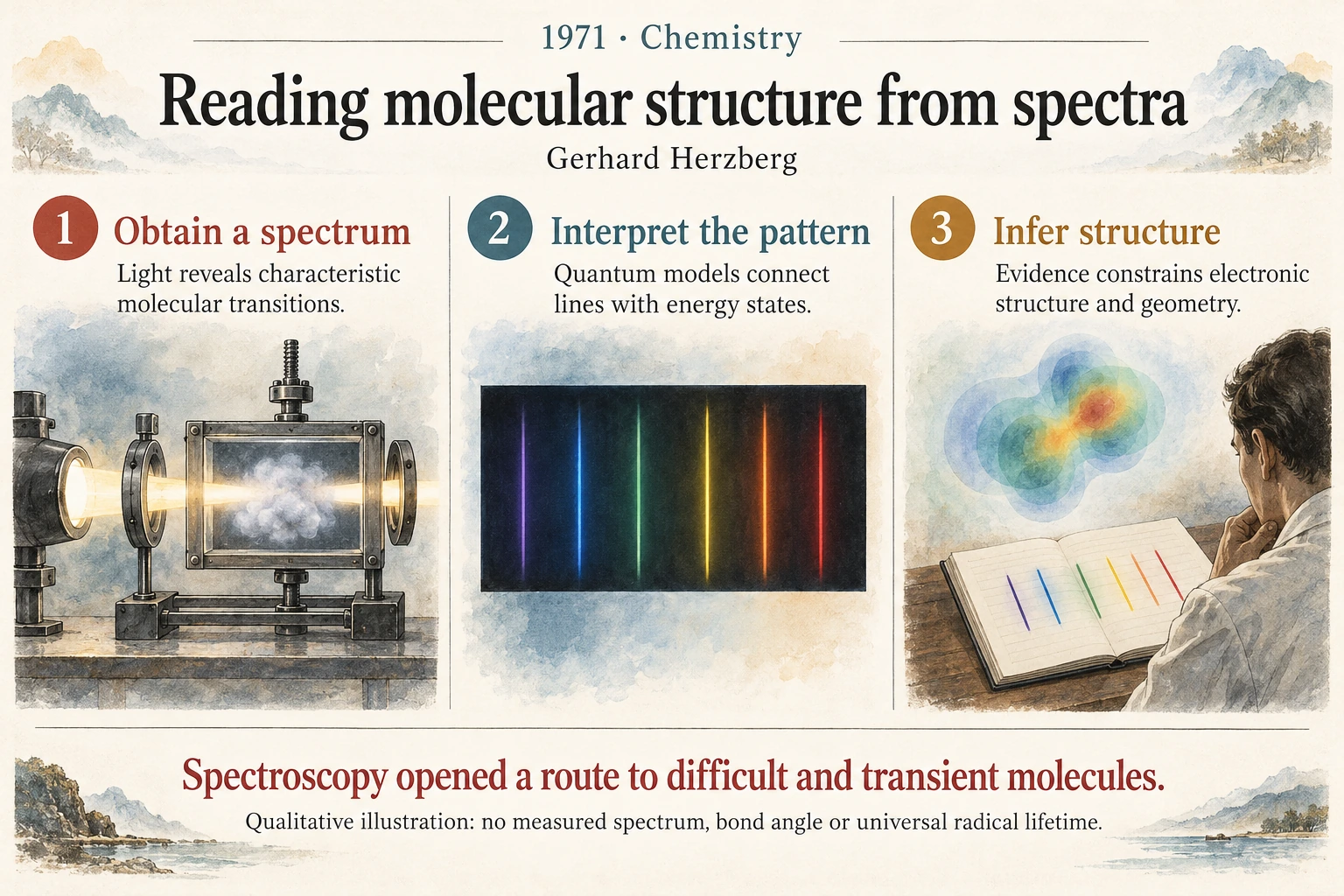
Molecules absorb or emit light at characteristic wavelengths related to transitions between allowed energy states. Rotation, vibration and electronic motion leave patterns that need careful quantum interpretation. Spectroscopy is evidence about a molecule, rather than a direct enlarged photograph of its atoms.
Herzberg and his associates developed experimental and analytical methods to identify structures, including difficult radicals. A radical has an unpaired electron; it is not simply any fragment produced during a reaction. Their investigations connected electronic states with geometry and also helped identify molecules in astronomical environments.
Why it matters
The work gave chemistry more reliable access to transient species that participate in reactions. It also connected laboratory measurements with the interpretation of light from planetary atmospheres, comets and interstellar space.