A life in context
The person behind the prize
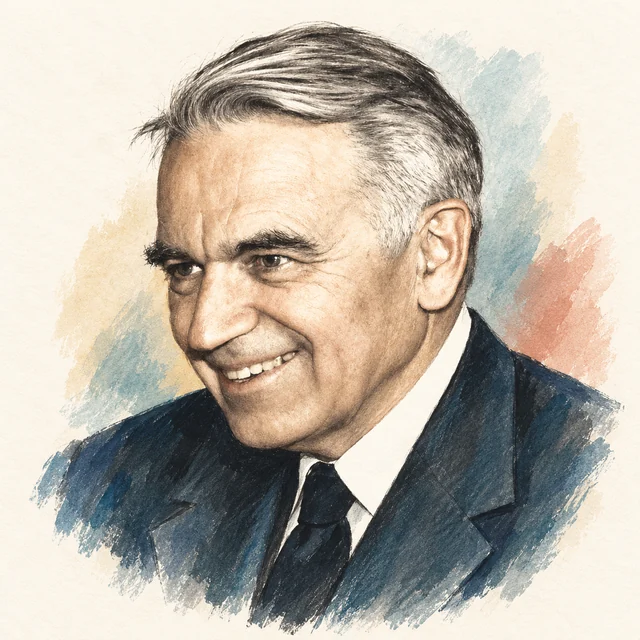
Herzberg trained in physics at Darmstadt, completing a doctorate in 1928. Postdoctoral work in Göttingen and Bristol preceded a return to Darmstadt as a lecturer. Forced to leave Germany as a refugee in 1935, he moved to Saskatchewan, where he became a research professor. After spectroscopy work at Chicago’s Yerkes Observatory from 1945 to 1948, he joined Canada’s National Research Council in Ottawa. He directed physics research and became a distinguished research scientist in 1969. Herzberg and his associates combined spectra and quantum interpretation to determine molecular electronic structure and geometry, including difficult, transient radicals. They also identified molecules in astronomical environments. The Chemistry Prize recognised this extensive spectroscopic work, grounded in his physics training. His biography credits associates as well as his own investigations; the achievement was a continuing research programme rather than a single photograph of a molecule.
The contribution
Herzberg developed spectroscopic knowledge of molecular electronic structure and geometry, especially free radicals. He received the entire Chemistry Prize.
The idea in plain language
Molecules absorb or emit light at characteristic wavelengths related to transitions between allowed energy states. Rotation, vibration and electronic motion leave patterns that need careful quantum interpretation. Spectroscopy is evidence about a molecule, rather than a direct enlarged photograph of its atoms.
Read the full award story ↗

