01 · The discovery
The idea, in everyday language
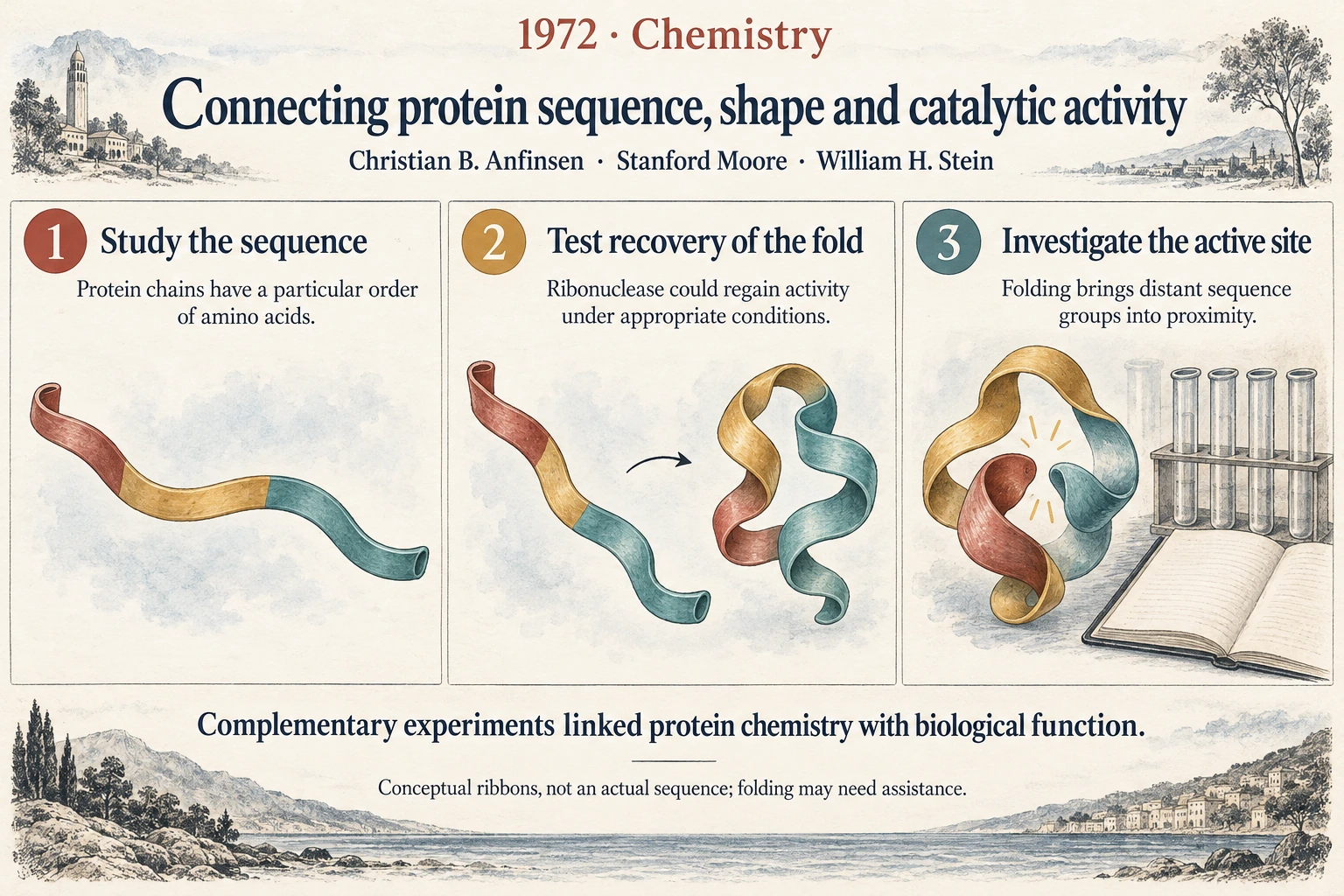
Anfinsen and colleagues disrupted ribonuclease’s folded structure and disulfide bonds, then studied recovery under appropriate conditions. The enzyme could regain its native form and activity. The sequence contained information needed for the active conformation, without a separate genetic template specifying its final shape. Assistance with folding can still affect how efficiently that state is reached.
Moore and Stein developed quantitative methods for separating and analysing amino acids and peptides. Chemical modification helped identify unusually reactive groups involved in catalysis. Groups far apart along a linear sequence can come together in the folded active site. These complementary approaches linked molecular composition, three-dimensional organisation and biological function.
Why it matters
The work established experimental foundations for understanding why a protein’s particular structure matters to its function. Analytical methods also made detailed protein chemistry more accessible. Anfinsen received half the prize; Moore and Stein shared the other half equally.