A life in context
The person behind the prize
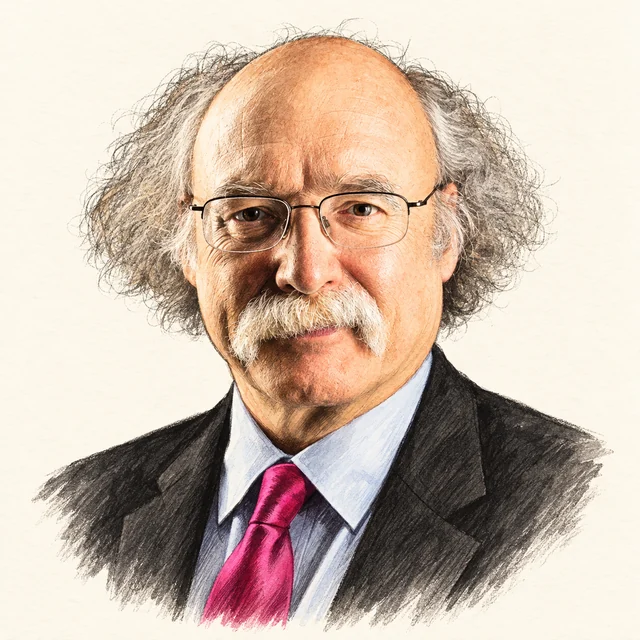
Haldane grew up in Britain and received his Cambridge doctorate in 1978 under Philip Anderson. He worked in France and at several American research institutions before joining Princeton in 1990. His theoretical studies challenged familiar expectations about magnets and electrical conduction. By concentrating on simplified models, he revealed distinctions between forms of matter that conventional descriptions had missed.
The contribution
He predicted a fundamental difference between antiferromagnetic quantum chains with integer and half-integer spin. He also devised a model showing how an integer quantum Hall state could arise without a net magnetic flux through the system, expanding the search for topological matter.
The idea in plain language
Water freezing is a familiar change of phase. In very thin materials, however, a different kind of transition can happen. Imagine arrows on a sheet recording a local direction. Around certain points the arrows wind all the way round: these are vortices. Kosterlitz and Thouless showed that opposite vortices can bind together at low temperature. When they separate, the collective behaviour changes, even though the usual description in terms of ordinary long-range order does not apply.
Read the full award story ↗