A life in context
The person behind the prize
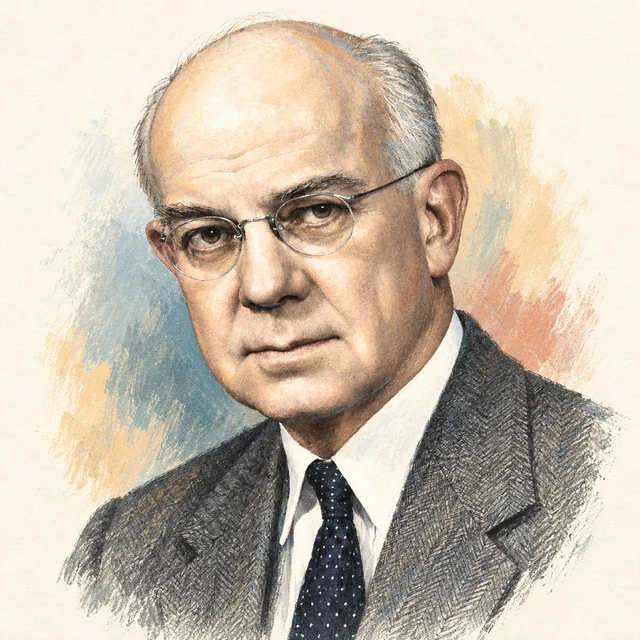
Kendall studied chemistry at Columbia, receiving his bachelor’s degree in 1908, master’s in 1909 and doctorate in 1910. After research at Parke, Davis and St Luke’s Hospital, he joined the Mayo Foundation in 1914 and became director of its biochemistry division in 1915. His earlier work included thyroid chemistry and thyroxine. During the 1930s his group investigated hormones of the adrenal cortex, distinguishing closely related substances and linking chemical structure with biological effects. Reichstein’s laboratory pursued related work independently, with exchanges between the groups. Cortisone, known in Kendall’s laboratory as Compound E, became available for Hench’s clinical investigations in 1948. Biochemists, industrial chemists and clinical colleagues were essential to that transition. Kendall’s 1950 award affiliation was Mayo Clinic, and he received one third of the Medicine Prize. Retirement and his move to Princeton as a visiting professor followed in 1951. His doctorate was in chemistry, rather than a medical qualification.
The contribution
Kendall isolated and identified adrenal cortical hormones and related their structures to biological actions, helping make cortisone available for clinical investigation. He received one third of the prize.
The idea in plain language
The adrenal cortex is the outer part of an adrenal gland. It produces several hormones with different effects, not one interchangeable substance. Kendall, Reichstein and their research groups separated closely related compounds and investigated their structures. Small chemical differences could accompany substantial differences in biological action.
Read the full award story ↗