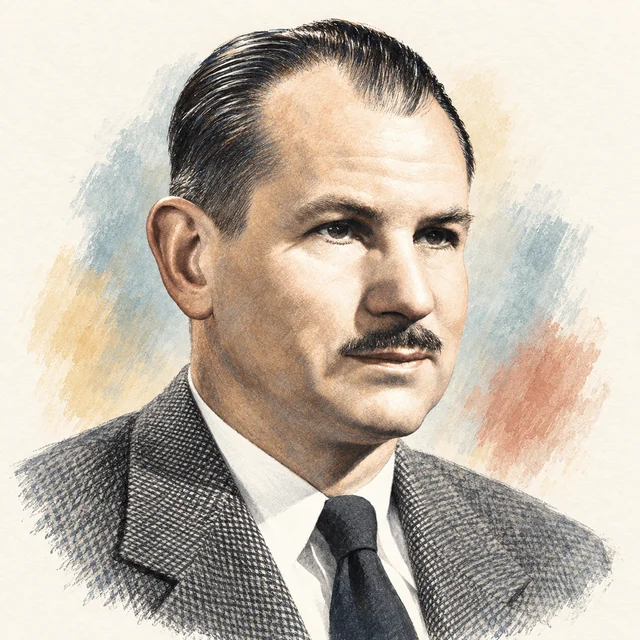
A life in context
The person behind the prize
McMillan graduated from Caltech in 1928, earned a master’s degree in 1929 and completed a Princeton doctorate on molecular beams in 1932. He joined Berkeley that year and moved from spectroscopy into nuclear research. With Philip Abelson in 1940 he identified neptunium, element 93, establishing a new chemical element beyond uranium. He also contributed to the early work that led to plutonium. Wartime assignments took him to radar and underwater-sound research and then Los Alamos. His separate 1945 work on phase stability helped the development of accelerators. He became professor at Berkeley in 1946, and Berkeley was his affiliation for his half of the 1951 Chemistry Prize. His appointment as Radiation Laboratory director in 1958 was later. The chemistry award recognised discovery and identification of transuranium elements, not only the construction of machines that could produce nuclear reactions.
The contribution
McMillan identified neptunium with Philip Abelson in 1940 and contributed to subsequent heavy-element research. He received one half of the prize for transuranium chemistry.
The idea in plain language
An element is defined by the number of protons in its nucleus. Uranium has 92; identifying something beyond it requires evidence for a different chemical element, not just a heavier isotope of uranium. In 1940 McMillan and Philip Abelson identified neptunium, atomic number 93. Chemical behaviour and radioactive evidence helped distinguish it from known material.
Read the full award story ↗