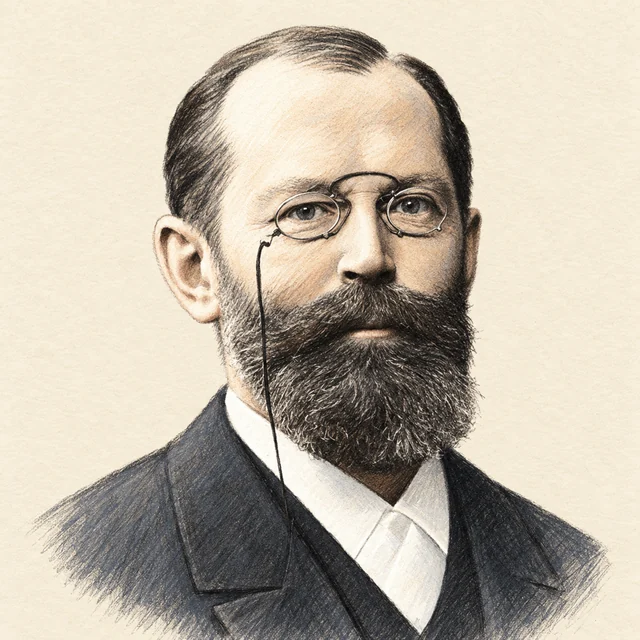
A life in context
The person behind the prize
Emil Fischer began studying chemistry at Bonn in 1871 and moved to Strasbourg the following year, where Adolf von Baeyer helped turn his interests decisively toward organic chemistry. He completed his doctorate in 1874, followed Baeyer to Munich in 1875 and later held a professorship at Erlangen. From 1885 to 1892 he directed the chemical institute at Würzburg, before moving to Berlin. His work brought order to families of biologically important substances that were difficult to distinguish and investigate. Sugars could have the same overall composition while differing in the arrangement of their atoms. Fischer used chemical transformations, comparison and synthesis to establish relationships among them and to infer relative spatial configurations. The work developed the stereochemical ideas of van ’t Hoff and Le Bel rather than simply listing new sweet substances. A second major programme concerned purines. Compounds including caffeine, uric acid, adenine and guanine could be understood as related members of a chemical family with a common structural framework. Fischer’s syntheses and interconversions helped test those relationships; he synthesised the parent purine in 1898. The full 1902 Chemistry Prize explicitly recognised work on both sugar and purine syntheses. His broader research included peptides and proteins, and his account of enzyme specificity used the influential lock-and-key comparison. That comparison is a useful historical model, but it does not mean that all enzymes and substrates are rigid objects. Nor did synthesis of a sugar amount to explaining every step of photosynthesis. Fischer also helped organise scientific institutions. His later career requires critical context: the University of Würzburg describes his wartime advisory involvement in the development of chemical warfare. Scientific achievement does not remove responsibility for such uses of expertise. He died in Berlin in 1919. His contribution to chemistry rests on joining proposed structures with experimentally tested relationships and syntheses, while later methods refined the picture of molecules in three dimensions.
The contribution
Fischer established relationships and relative configurations among sugars and clarified the purine family through synthesis. The full Chemistry Prize recognised both areas, beyond his other work on proteins or enzyme models.
The idea in plain language
Sugars can share a composition yet differ in how atoms are arranged in space. Fischer compared their chemical transformations and made related compounds, using the relationships to establish relative configurations. Stereochemistry made a family of similar substances intelligible without treating them as identical.
Read the full award story ↗

