A life in context
The person behind the prize
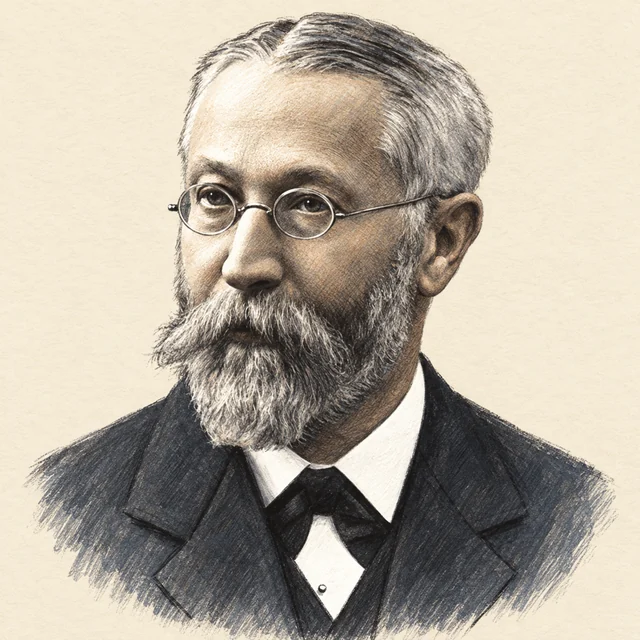
Karl Ferdinand Braun studied in Marburg and Berlin, completing a doctorate on oscillating strings in 1872. After work in Würzburg and teaching in Leipzig, he held academic posts in Marburg and Strasbourg. As a physics professor in Karlsruhe from 1883 to 1885, he helped establish electrical engineering teaching there. He then moved to Tübingen and returned to Strasbourg in 1895 to lead its Physics Institute. His investigations ranged from thermodynamics to electrical conduction, including departures from Ohm’s law in particular materials. A cathode-ray oscillograph constructed in 1897 became another influential contribution, distinct from the reason for his Nobel Prize. From 1898 he worked on wireless telegraphy. Introducing a closed oscillating circuit coupled to the radiating system improved the strength and tuning of transmissions, helping receivers distinguish a desired signal from other stations. He also investigated directional aerials. Braun shared the 1909 Physics Prize equally with Guglielmo Marconi; their contributions belonged to a wider field of research and engineering, rather than a single jointly built apparatus. Patent litigation took Braun to the United States during the First World War. Illness and separation from his laboratory curtailed his work, and he died in Brooklyn in 1918. His improvements reduced difficulties in wireless communication without eliminating interference altogether.
The contribution
Braun received half the Physics Prize for contributions to wireless telegraphy. Improved oscillating circuits, coupling and tuning made transmissions more effective and selective.
The idea in plain language
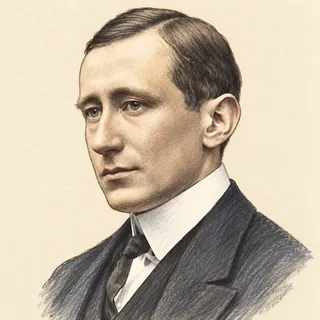
Hertz’s experiments had shown that electromagnetic waves could travel through space. A useful communication system still required ways to generate, radiate, detect and distinguish signals over much greater distances. Marconi assembled and improved equipment, conducted demonstrations and built commercial services linking shore stations and ships. Telegraph messages were encoded in timed signals, rather than transmitted as ordinary speech.
Read the full award story ↗