A life in context
The person behind the prize
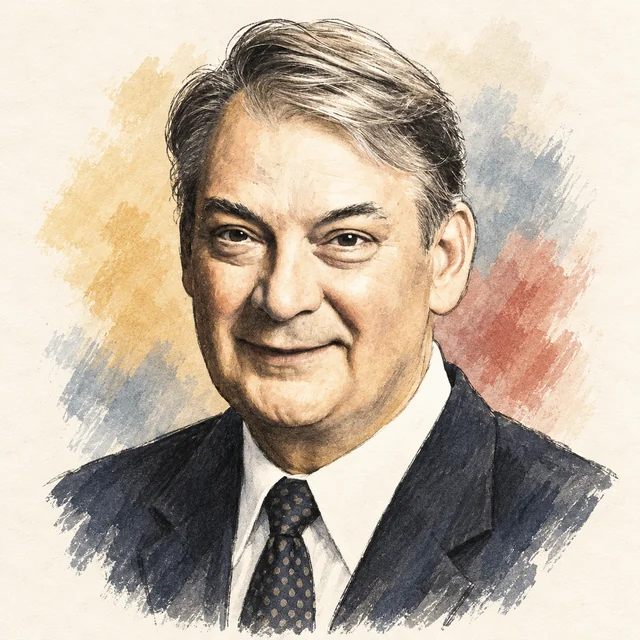
Murad grew up in Indiana, where his parents ran a restaurant. He studied at DePauw and trained in medicine and research at Case Western Reserve. His career included work at Virginia, Stanford and Houston. Combining clinical questions with biochemical experiments, he examined how vasodilating drugs change the internal signalling machinery of cells.
The contribution
Murad’s 1977 work linked nitric oxide and nitrovasodilators to activation of guanylate cyclase and increased cyclic GMP, which promotes smooth-muscle relaxation. He proposed that naturally produced signals might use this pathway too. The later identification of EDRF as nitric oxide connected his drug studies with signalling from endothelial cells. His contribution was the biochemical mechanism, rather than the initial discovery of EDRF.
The idea in plain language
Experiments on blood vessels sometimes gave conflicting results. Furchgott showed in 1980 that acetylcholine caused relaxation only when the endothelium, the inner cell lining, remained intact. He inferred that it released a signal to the underlying smooth muscle. Murad had already connected nitric oxide and vasodilator drugs to a biochemical pathway that raises cyclic GMP and promotes relaxation.
Read the full award story ↗