01 · The discovery
The idea, in everyday language
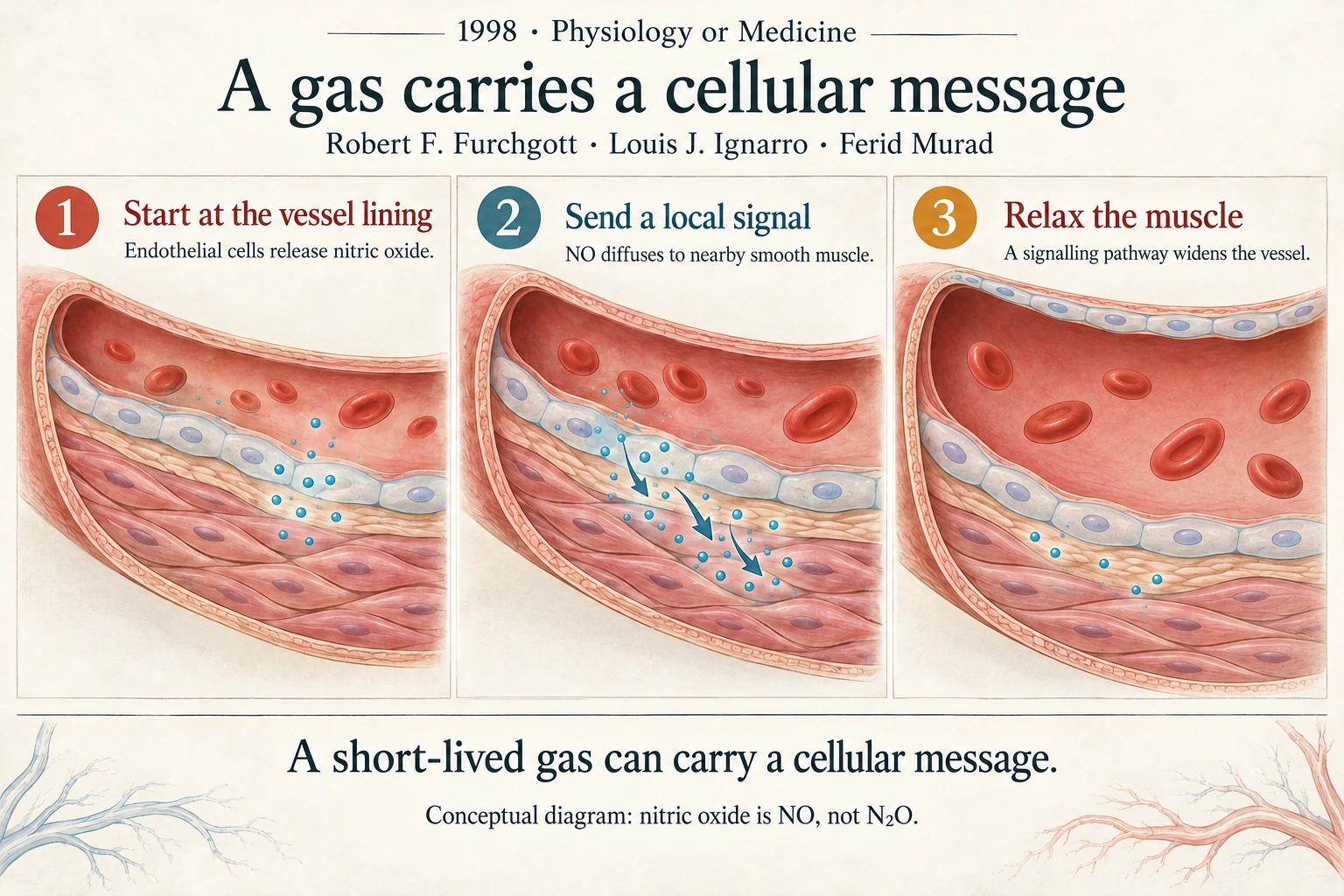
Experiments on blood vessels sometimes gave conflicting results. Furchgott showed in 1980 that acetylcholine caused relaxation only when the endothelium, the inner cell lining, remained intact. He inferred that it released a signal to the underlying smooth muscle. Murad had already connected nitric oxide and vasodilator drugs to a biochemical pathway that raises cyclic GMP and promotes relaxation.
In 1986 Ignarro and Furchgott independently concluded that the endothelium-derived relaxing factor was nitric oxide. A small, short-lived gas could pass between cells and regulate their activity. The three contributions joined the source of the signal, its chemical identity and its intracellular mechanism into a new understanding of vascular control.
Why it matters
The discovery changed the understanding of blood-flow regulation and the action of important vasodilator drugs. It also launched research into nitric oxide in nerves, immunity and other tissues. These later roles depend on where, how much and for how long the molecule is produced.