A life in context
The person behind the prize
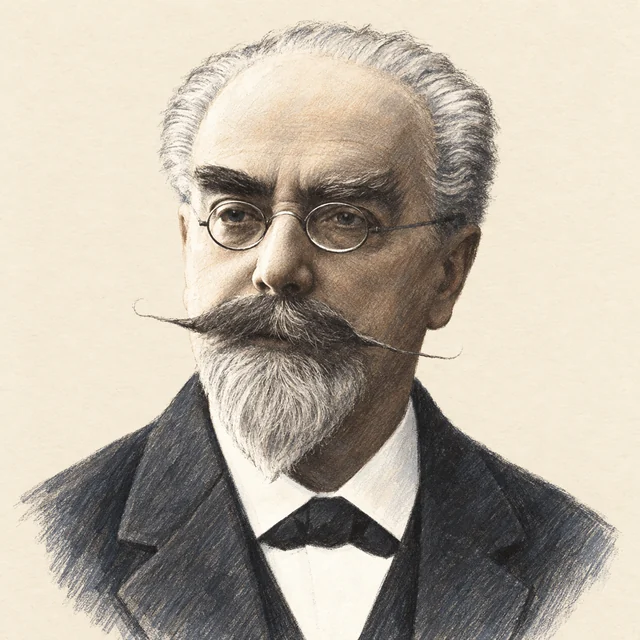
Gabriel Lippmann was born in Luxembourg to French parents and grew up in Paris. He entered the École normale supérieure in 1868, but his interest in experimental research did not translate into success in the examination required for teaching. A scientific mission to Germany in 1873 brought him into contact with laboratories in Heidelberg and Berlin, including work associated with Kirchhoff and Helmholtz. He joined the Paris science faculty in 1878, became professor of mathematical physics in 1883 and took the experimental-physics chair at the Sorbonne in 1886. His investigations ranged across electrical measurement, thermodynamics and optics. The capillary electrometer was one important contribution, but his 1908 Nobel Prize concerned another problem: how to retain the colours of a scene in a photograph. In 1891 he announced a method using interference between incoming light and light reflected back through a sensitive layer. Development left microscopic silver structures whose spacing recorded information about wavelength. The colours were reconstructed optically rather than supplied by coloured pigments. Further demonstrations and a fuller theory followed during the 1890s. Lippmann received the whole Physics Prize in 1908. The method produced striking plates but did not become everyday colour photography; viewing conditions mattered, and later analysis found differences between recorded and reconstructed spectra. He continued scientific and institutional work and died at sea in 1921 while returning from a mission to North America. His career shows how an elegant physical experiment could open a new way of recording light without becoming the dominant practical technology.
The contribution
Lippmann received the full Physics Prize for a photographic colour method based on interference. Fine structures inside a sensitive layer recorded wavelength information and reconstructed colour in reflected light.
The idea in plain language
Light travels as waves. When incoming light meets light reflected back from a mirror behind a sensitive photographic layer, the two waves interfere. Their interaction produces a standing pattern of stronger and weaker illumination. Development leaves fine structures containing silver at different depths, with spacing related to the wavelength inside the material.
Read the full award story ↗

