A life in context
The person behind the prize
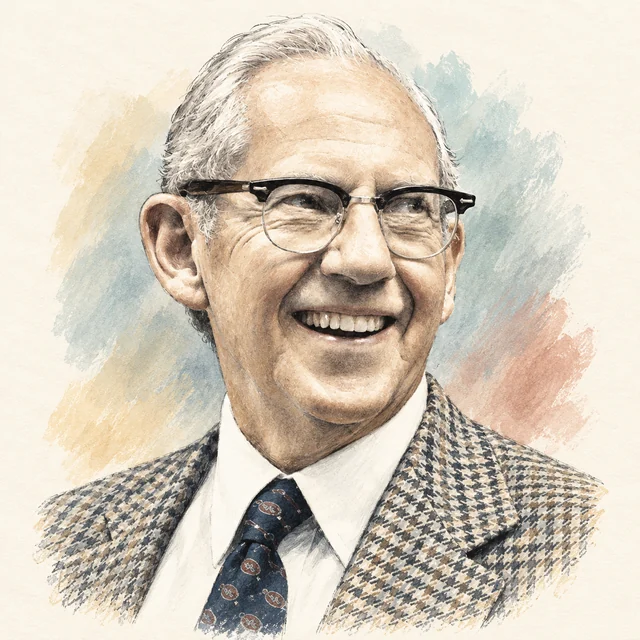
Stigler graduated from the University of Washington in 1931, studied at Northwestern, and completed his Chicago doctorate in 1938 under Frank Knight. He taught at Iowa State and Minnesota, worked in Columbia’s wartime Statistical Research Group, and later held posts at Brown and Columbia. In 1958 he returned to Chicago. His research combined price theory, historical scholarship and evidence on how industries actually operated. The Economics of Information, published in 1961, treated finding prices as a costly activity. His work on oligopoly asked how firms could detect departures from collusion; his regulation research asked which groups sought rules and who benefited. Collaborators, including Claire Friedland, contributed to this empirical programme. The award recognised several connected fields rather than a single policy slogan.
The contribution
Stigler explained market behaviour by studying information costs, industrial structure and incentives surrounding regulation. His questions brought observed price differences and the political origins of rules into economic analysis. He received the full Sveriges Riksbank memorial prize. Regulatory capture is an explanation to investigate, not proof that every rule necessarily benefits producers or that all regulation should be removed.
The idea in plain language
Perfect information is a convenient assumption, but a buyer usually must spend time or resources to compare offers. Stigler treated that search as an economic activity. An additional enquiry may uncover a better price, yet its expected benefit can be smaller than its cost. Price dispersion can therefore persist even when participants respond to incentives.
Read the full award story ↗