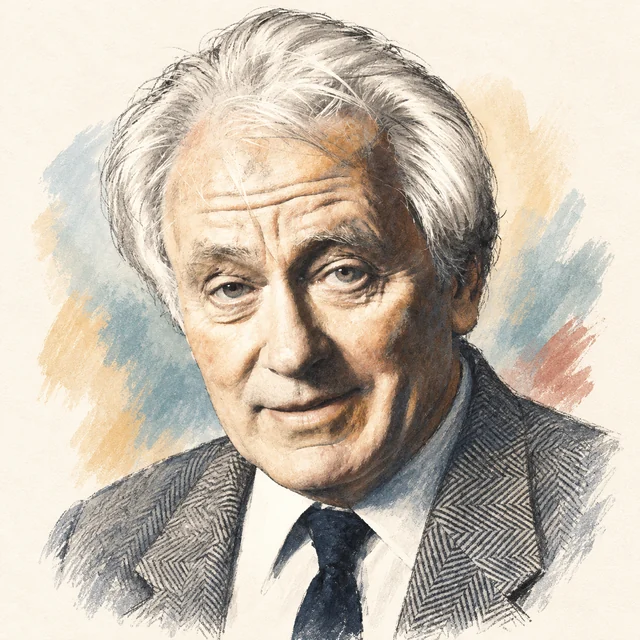
A life in context
The person behind the prize
Charpak was born in Poland and made his scientific career in France and at CERN. Engineering studies at the École des Mines preceded experimental nuclear-physics research at the Collège de France and a doctorate in 1954. He joined CERN in 1959, developing instruments that replaced slow photographic recording with electronic signals. His interests also extended to applying detectors in biological research and X-ray imaging.
The contribution
Charpak invented and developed the multiwire proportional chamber, introduced in 1968. A charged particle ionises gas; freed electrons move toward fine anode wires and multiply near them. Individual electronic readouts locate signals, and several detector layers help reconstruct a track. The advance made rapid, computer-based recording practical. It identifies interactions through their signals rather than photographing the particles themselves, and its performance depends on the detector design.
The idea in plain language
A particle track had often meant a photograph that someone had to measure. That approach limited how quickly experiments could inspect collisions. Charpak’s multiwire proportional chamber used a gas-filled detector with many thin, parallel anode wires. A passing charged particle ionises the gas, leaving electrons and positive ions rather than a visible photographic line.
Read the full award story ↗

