01 · The discovery
The idea, in everyday language
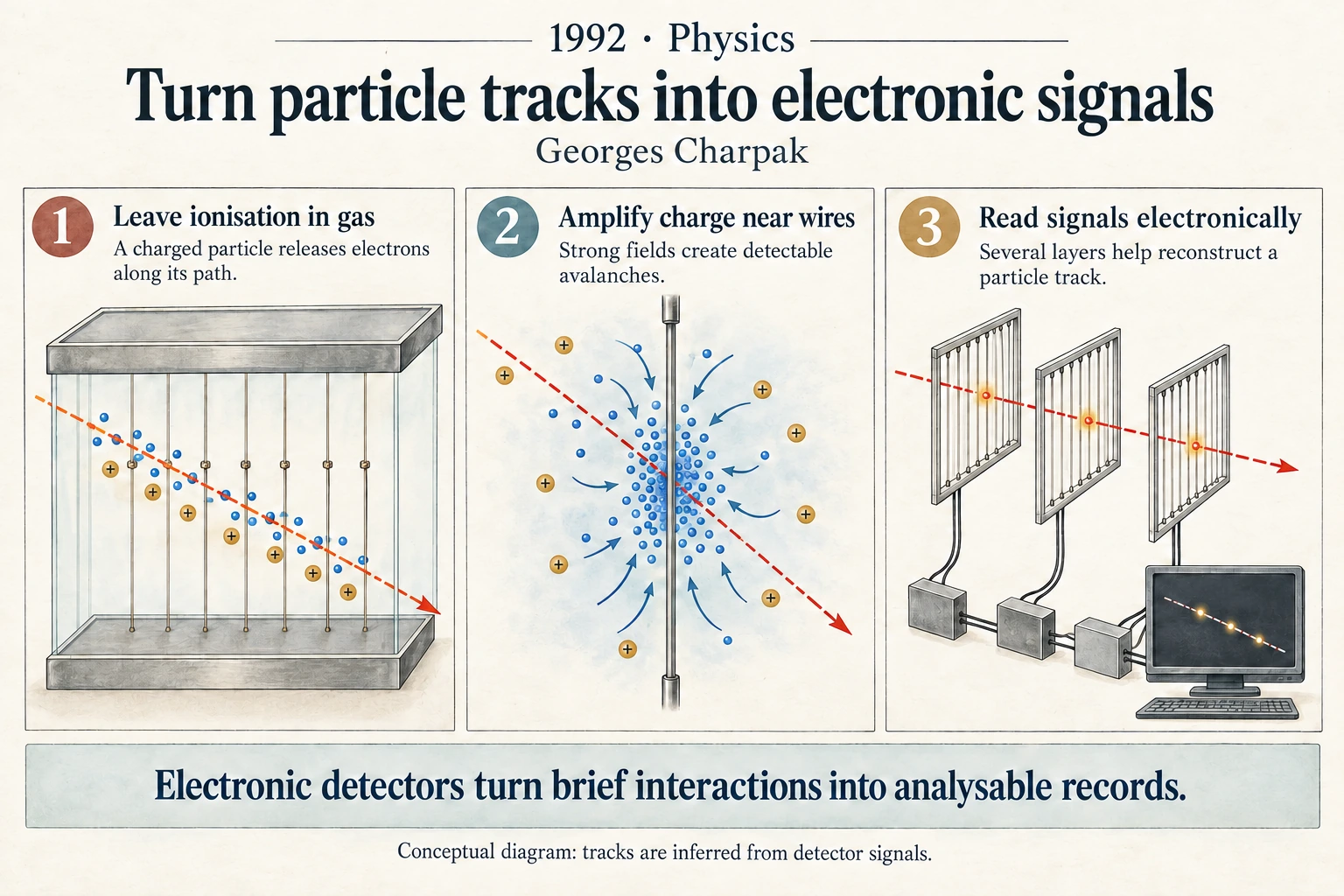
A particle track had often meant a photograph that someone had to measure. That approach limited how quickly experiments could inspect collisions. Charpak’s multiwire proportional chamber used a gas-filled detector with many thin, parallel anode wires. A passing charged particle ionises the gas, leaving electrons and positive ions rather than a visible photographic line.
An electric field moves the freed electrons toward anode wires. Close to a wire, a strong field produces an avalanche of further ionisation, giving a detectable electrical signal. Each wire has its own readout. Computer recording and signals from multiple layers allow researchers to infer track positions rapidly, helping experiments investigate rare interactions amid many ordinary events.
Why it matters
The chamber helped move particle physics into an era of electronic detection and computer analysis. Later detector designs built on the principle, contributing to major experiments. Related techniques also found uses in radiation imaging and biological research, where appropriate detector design and exposure remain essential.