c.curionodeThe Nobel Archive

1994 · Physics

Where atoms are, and what they do

Neutron scattering became a way to investigate both the arrangement of matter and the motions within it.

neutron scatteringatomic structurecollective vibrationscondensed matter
1994Physics

Visual guide

The prize, pictured

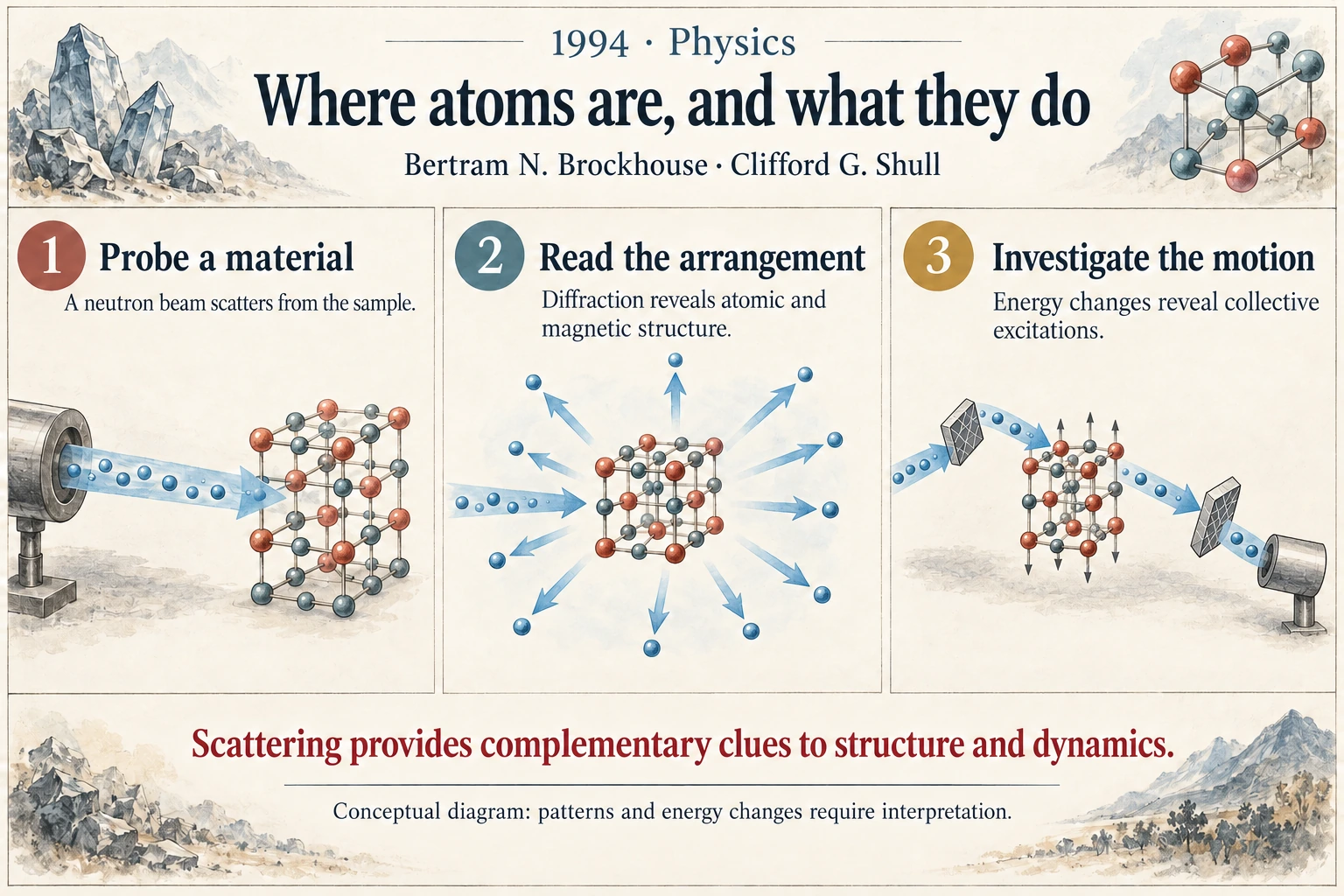
Infographic explaining Where atoms are, and what they do
Original AI-generated infographic. A conceptual overview; the explanations and sources below provide context.
Read the poster text

Scattering provides complementary clues to structure and dynamics.

  1. Probe a material

    A neutron beam scatters from the sample.

  2. Read the arrangement

    Diffraction reveals atomic and magnetic structure.

  3. Investigate the motion

    Energy changes reveal collective excitations.

Conceptual diagram: patterns and energy changes require interpretation.

01 · The discovery

The idea, in everyday language

A material’s properties depend on how its atoms are arranged and how they move together. Neutrons can probe both questions. When a beam meets a sample, the directions in which neutrons scatter carry information about structure. Shull developed diffraction methods that made these patterns interpretable, including ways to locate hydrogen and investigate magnetic ordering.

Brockhouse developed the complementary study of energy changes. Inelastic scattering can transfer energy between neutrons and collective excitations in the sample, such as vibrations called phonons. His triple-axis spectrometer selects incoming neutron energies, scatters them from a sample and analyses their outgoing energies. Together these techniques made neutron beams powerful tools for condensed-matter research, rather than merely a source of nuclear reactions.

Why it matters

The methods opened ways to study crystals, liquids, magnetic materials, polymers and biological structures. They connect microscopic organisation and collective motion to material properties. Later instruments and sources extended the reach of this work; the prize recognises the pioneering methods rather than every later application.

02 · The people

Who brought the idea to life?

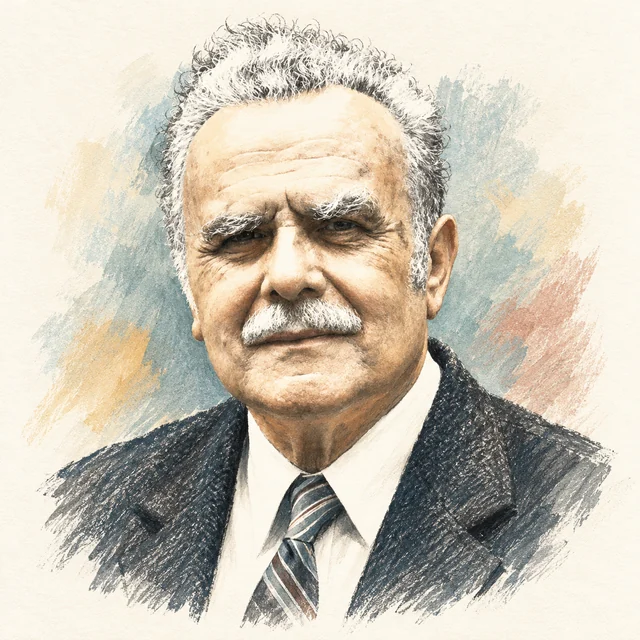
Illustrated portrait of Bertram N. Brockhouse

Bertram N. Brockhouse

Prize share · 1/2

Brockhouse developed neutron spectroscopy, especially the triple-axis spectrometer, to measure how a neutron’s energy changes when it interacts with a material. Those changes reveal excitations such as collective atomic vibrations, rather than just the positions of atoms. His 1950s experiments and instrument design made inelastic scattering a practical tool. He received half the prize; Shull’s complementary half concerned diffraction and structure.

Read the biography ↗
Illustrated portrait of Clifford G. Shull

Clifford G. Shull

Prize share · 1/2

Shull helped establish neutron diffraction as a reliable method of determining atomic and magnetic structure. Scattering directions carry information about the arrangement of atoms, including hydrogen that is difficult to locate with many X-ray measurements. Neutron magnetic interactions also reveal magnetic ordering. Wollan was an essential collaborator, but died before the award; Shull received half the prize for the diffraction technique.

Read the biography ↗

03 · Years in the making

The path here

  1. 1946

    Shull joins Wollan at Oak Ridge to develop neutron diffraction.

  2. 1955

    Brockhouse and Stewart report measurements of collective vibrations in crystals.

  3. 1956

    Brockhouse’s group completes its first true triple-axis crystal spectrometer.

  4. 1994

    The Physics Prize honours neutron spectroscopy and diffraction with equal halves.

04 · Read further

From the original sources

Original explanations by Curionode, based on the official records below. Biographical details and affiliations refer to the award year.

  1. Official announcement nobelprize.org