A life in context
The person behind the prize
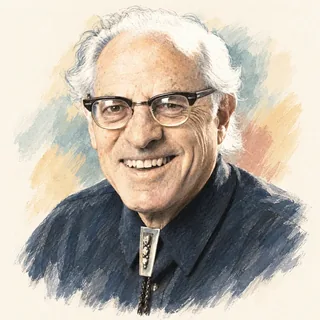
Perl grew up in Brooklyn and first trained as a chemical engineer. Industrial work encouraged him to return to study physics, earning a doctorate at Columbia before research at Michigan and Stanford. At Stanford’s accelerator laboratory, he pursued questions about the electron and its heavier relative, the muon. Looking for another member of this family required attention to unusual collision events rather than a direct photograph of a new particle.
The contribution
Perl led the experimental investigation that identified the tau, a third and much heavier charged lepton. Beginning in 1974, the team observed unusual electron–muon events at the SPEAR collider, with energy carried away by unseen particles. The 1975 report and subsequent tests supported production and decay of tau–antitau pairs. His half of the prize recognised this discovery; Reines’s separate half concerned the detection of the neutrino.
The idea in plain language
The 1995 prize joined two distinct discoveries. Perl’s team investigated electron–positron collisions and found events that existing particles could not adequately explain. Unusual electron–muon combinations, together with missing energy, supported the production and decay of a new heavy charged lepton: the tau. The claim emerged from testing alternatives and gathering further evidence, not from observing a visible tau track.
Read the full award story ↗