01 · The discovery
The idea, in everyday language
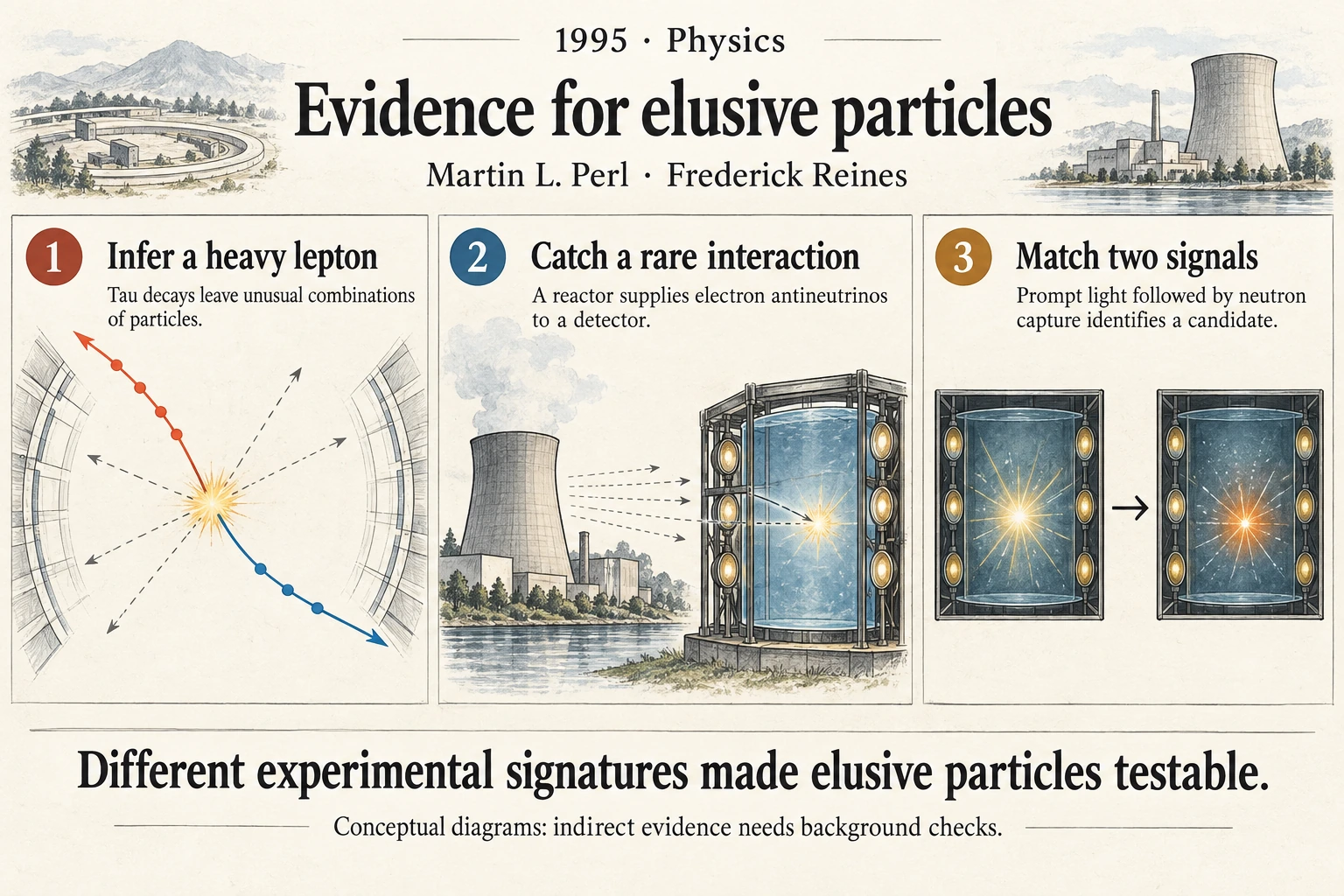
The 1995 prize joined two distinct discoveries. Perl’s team investigated electron–positron collisions and found events that existing particles could not adequately explain. Unusual electron–muon combinations, together with missing energy, supported the production and decay of a new heavy charged lepton: the tau. The claim emerged from testing alternatives and gathering further evidence, not from observing a visible tau track.
Reines and Cowan tackled a different problem: detecting free electron antineutrinos. A reactor supplied enormous numbers, while a water-based target and scintillation detectors caught rare interactions. A positron-related prompt signal followed by delayed neutron capture gave a characteristic coincidence. Their 1956 result established a practical way to detect a particle whose existence had first been proposed to account for energy in beta decay.
Why it matters
The tau established a third charged-lepton generation alongside the electron and muon. Neutrino detection opened a field of experiments using reactors and natural sources to investigate weak interactions and the universe. The two halves reward different advances, even though both concern leptons and invisible particles appear in each story.