01 · The discovery
The idea, in everyday language
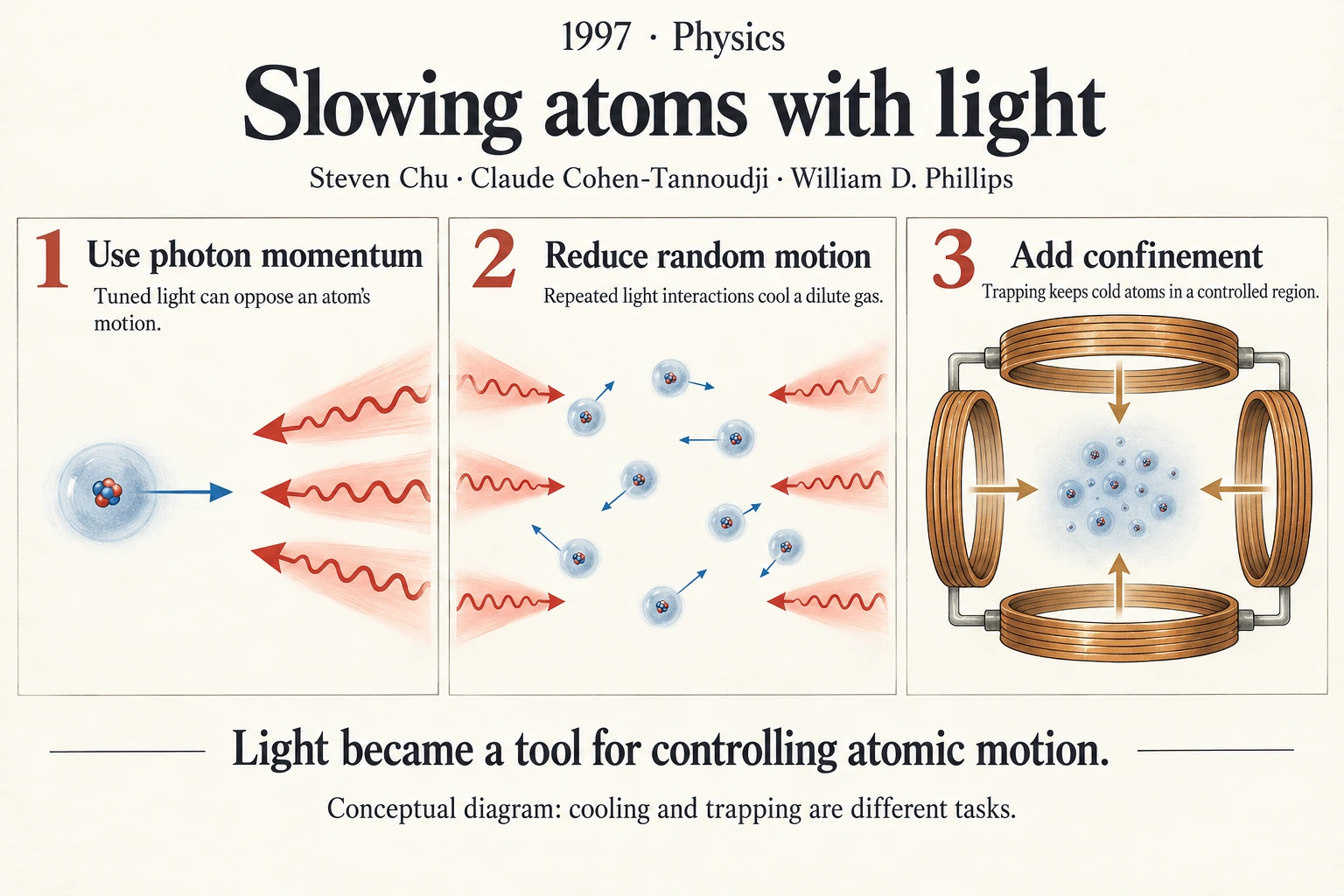
Light usually brings heating to mind, but a photon also carries momentum. An atom moving toward a suitably tuned laser can absorb light preferentially from the opposing direction, reducing its motion. Repeated absorption and emission, with beams arranged along different directions, can damp a gas’s random motion. Chu’s optical-molasses experiments made this three-dimensional cooling practical.
Phillips developed beam-slowing and trapping methods and measured temperatures below the expected Doppler limit. Cohen-Tannoudji explained additional cooling mechanisms using realistic internal atomic states and developed dark-state methods for still lower temperatures. Their work turned atoms’ interaction with light into a set of precise tools; cooling and spatial confinement are related but different tasks.
Why it matters
Cold, controllable atoms enabled precision spectroscopy, atomic-clock techniques and experiments on dilute quantum gases. Cooling and trapping methods helped open the route to Bose–Einstein condensation. The award recognized enabling methods rather than a claim that every laser cools matter or that absolute zero was reached.