01 · The discovery
The idea, in everyday language
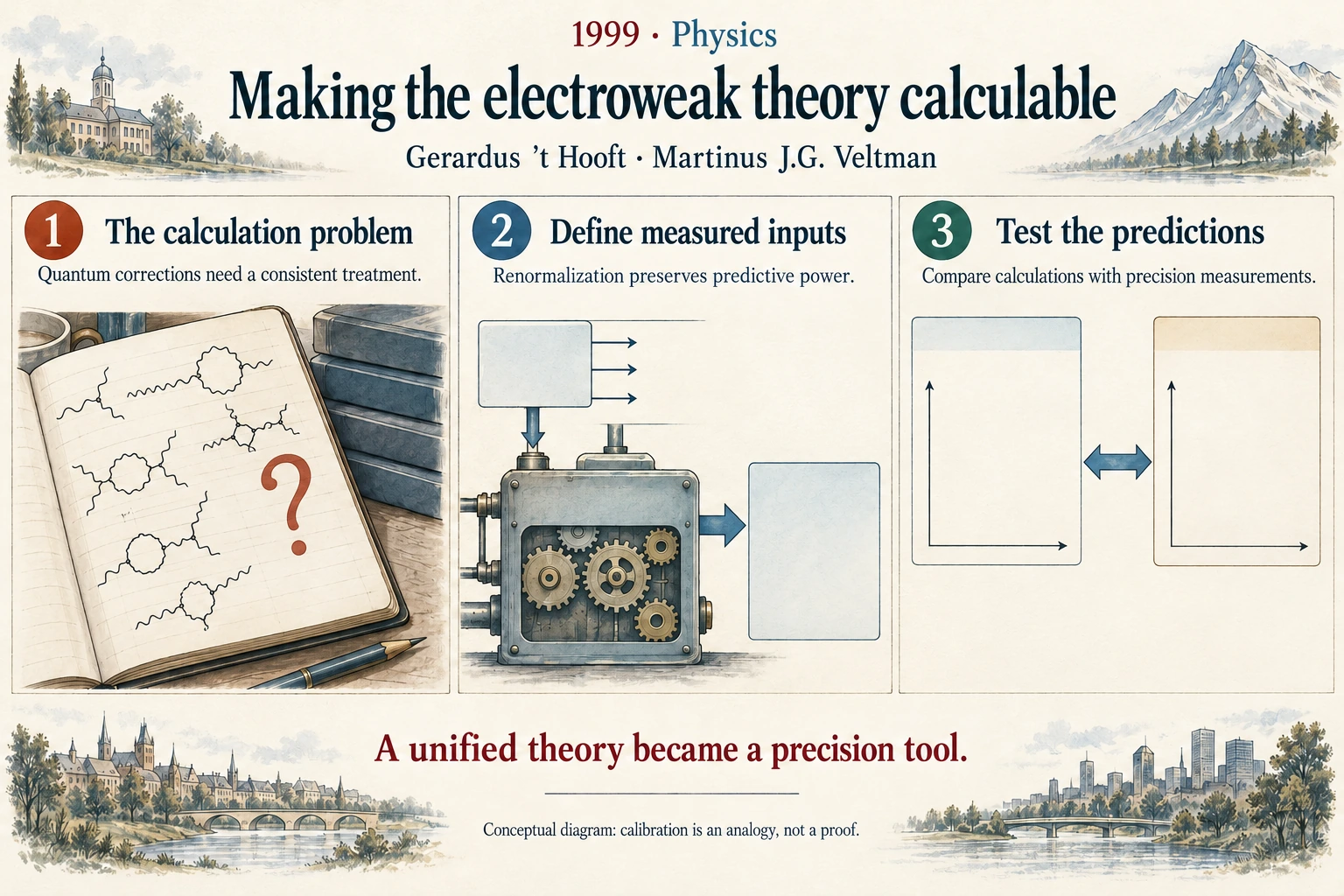
The electroweak theory described two forces within a common mathematical framework, but calculating quantum corrections could produce divergent expressions. A theory that describes a pattern without yielding usable numbers cannot face a precision test. The challenge was to show that its complicated corrections could be handled consistently while keeping a finite set of measurable inputs.
Veltman pursued this problem and built tools for symbolic calculation. In 1971 his student ’t Hooft established crucial renormalization results, including for theories with spontaneous symmetry breaking. Together they checked the mathematics and developed practical calculation methods. Predictions could then be compared with measurements, and quantum corrections could reveal indirect information about heavier particles.
Why it matters
Their work made the electroweak theory a precision framework within the Standard Model. Comparisons between calculations and collider measurements provided demanding tests and helped constrain the top-quark mass before its direct observation. The prize recognized the quantum structure and calculational foundations, rather than the original unification proposal alone.