01 · The discovery
The idea, in everyday language
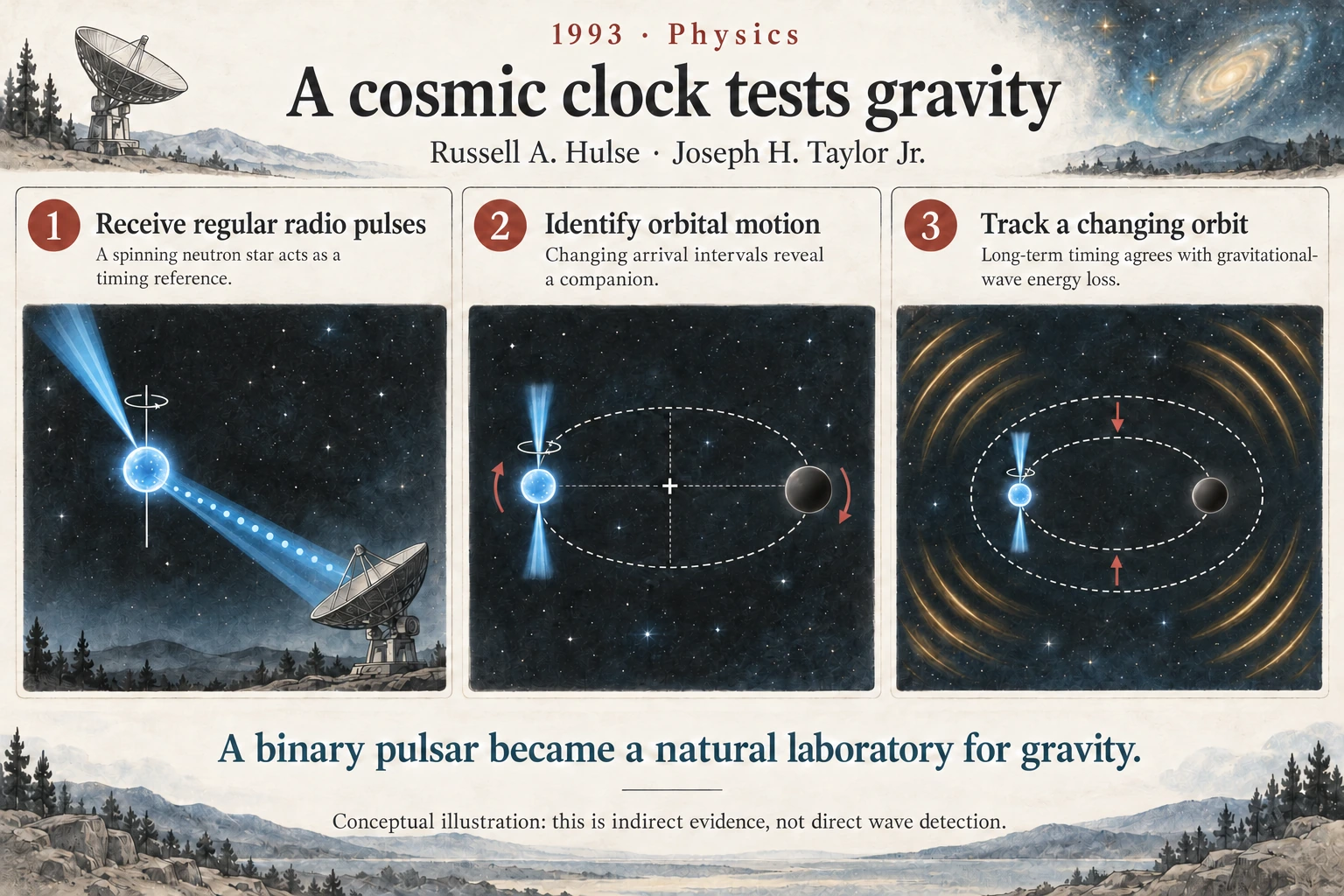
A pulsar is a rotating neutron star whose radio beam can sweep past Earth at remarkably regular intervals. In 1974, Hulse and Taylor found one whose apparent pulse rate changed over hours. The pattern revealed orbital motion around an unseen companion: approaching pulses arrived more often, receding pulses less often. This was the first known binary pulsar, not the discovery of pulsars themselves.
Long-term timing then made the system a precision experiment. Taylor and colleagues found that its orbital period gradually decreased, as expected if the pair lost energy through gravitational radiation. The radio pulses were the observations; the gravitational-wave energy loss was inferred from the changing orbit. Other relativistic effects also made the system a demanding test of gravity.
Why it matters
The discovery opened an astrophysical laboratory beyond the weak gravitational fields of the Solar System. It showed how patient radio observations could test predictions that were difficult to investigate on Earth. The prize connects finding an unusual system with learning to use it for precise measurements.