01 · The discovery
The idea, in everyday language
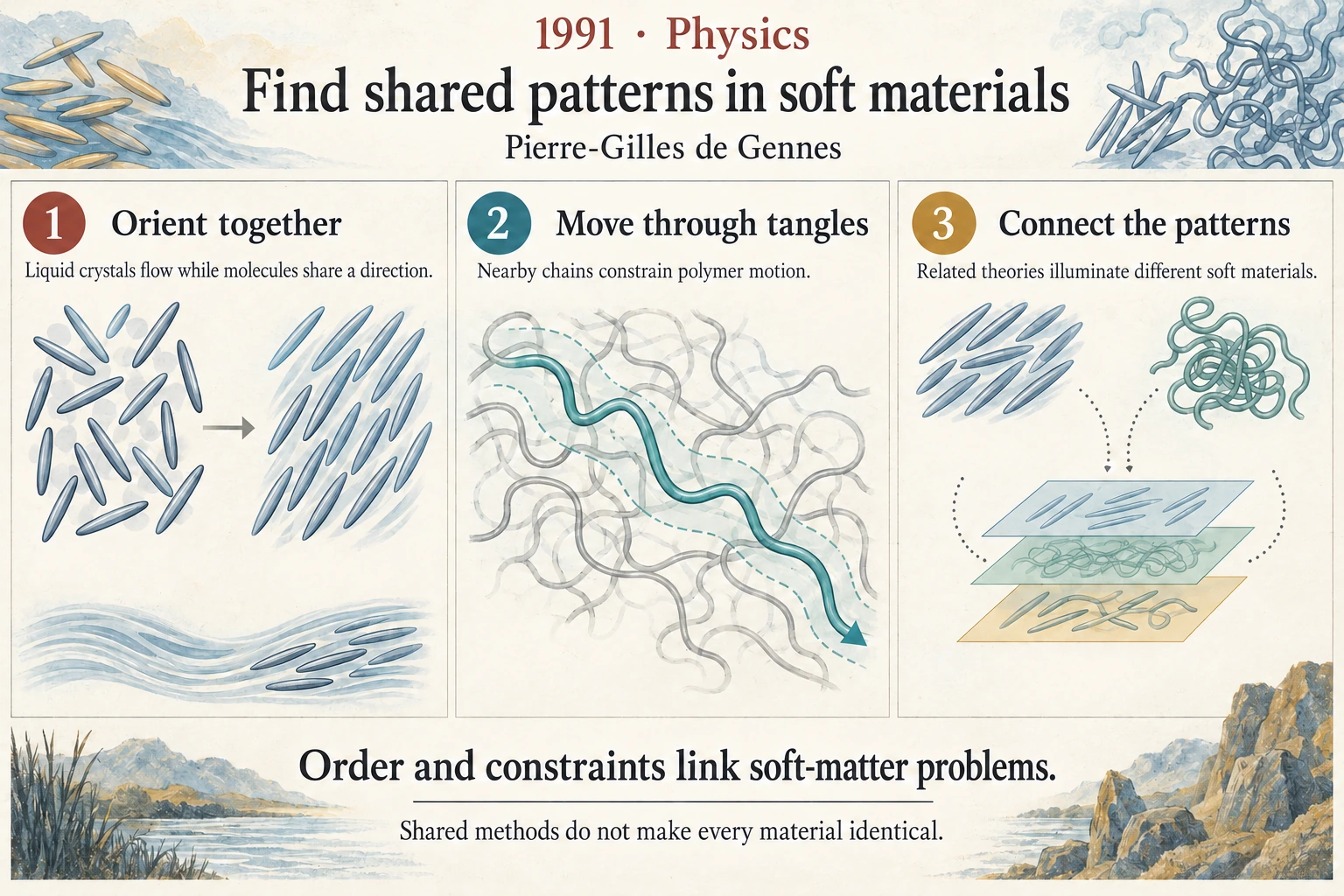
A liquid crystal can flow while its elongated molecules share a preferred direction. A polymer is a long chain whose motion depends on other chains around it. These materials seemed very different from simpler systems used to study magnetism and superconductivity. De Gennes showed how concepts of order, fluctuations and large-scale behaviour could travel between such problems.
He developed descriptions of liquid-crystal alignment and used scaling ideas to connect polymer behaviour across length scales. For entangled chains, the surrounding chains constrain sideways motion: a chain can move more easily along a path shaped by its neighbours. This conceptual tube is a model of constraints, not a solid tube surrounding each molecule. The connections provided useful predictions while leaving each material’s details important.
Why it matters
The work gave soft-matter physics a coherent set of tools for understanding liquid crystals, plastics and complex fluids. It linked abstract theory to material properties and experiments. Practical devices depend on many additional discoveries and engineering choices; de Gennes did not invent every liquid-crystal display or polymer material.