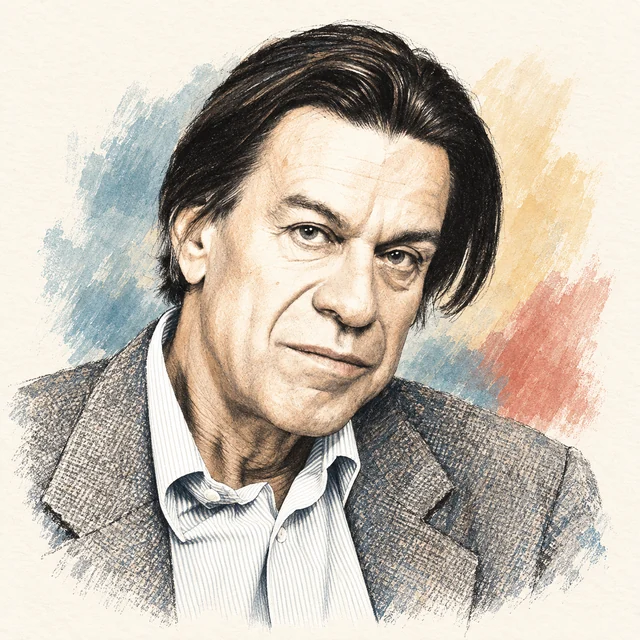
A life in context
The person behind the prize
De Gennes studied at the École Normale Supérieure and researched magnetism at Saclay, completing his doctorate in 1957. After work at Berkeley and military service, he built a superconductivity group at Orsay. He turned to liquid crystals in 1968 and later to polymers at the Collège de France. His work connected physical theory to materials that can bend, flow and reorganise; teaching and dialogue with experimentalists remained central to his approach.
The contribution
De Gennes adapted ideas developed for relatively simple ordered systems to more complex materials, notably liquid crystals and polymers. He related molecular alignment to descriptions of other ordering transitions, and explained large-scale polymer behaviour using scaling and constraints from tangled chains. These were tools for finding connections across different materials, not a claim that all transitions or all molecules behave identically. He received the whole Physics Prize.
The idea in plain language
A liquid crystal can flow while its elongated molecules share a preferred direction. A polymer is a long chain whose motion depends on other chains around it. These materials seemed very different from simpler systems used to study magnetism and superconductivity. De Gennes showed how concepts of order, fluctuations and large-scale behaviour could travel between such problems.
Read the full award story ↗

