A life in context
The person behind the prize
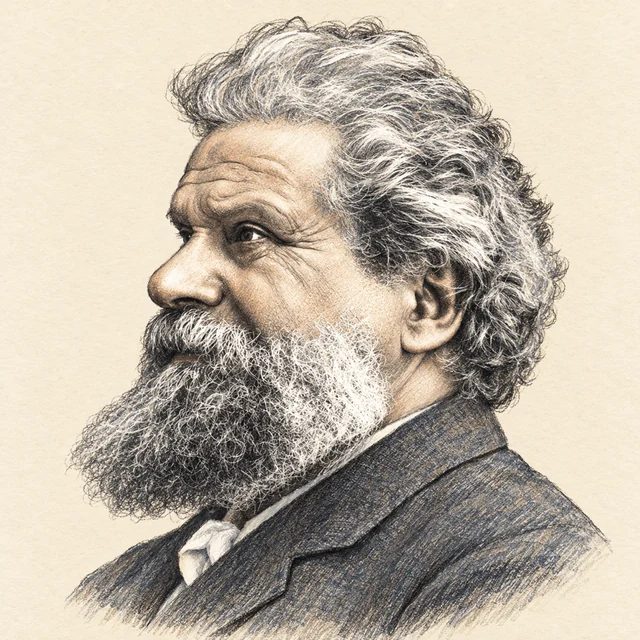
Giosuè Carducci grew up in Tuscany, where landscape, Latin literature and the politics of Italian unification shaped his imagination. His father was a physician with liberal political commitments. Carducci studied at the Scuola Normale Superiore in Pisa, taught in secondary schools and published Rime in 1857. He took the chair at the University of Bologna in 1860 and remained a central figure in its literary teaching until retirement in 1904. Scholarship and poetry developed together: close study of earlier Italian writers informed experiments in the resources of modern Italian verse. His early republican and anticlerical commitments appeared forcefully in political writing. Inno a Satana, published in 1865, used a provocative figure to celebrate free thought and progress rather than a literal programme of occult worship. Collections such as Levia Gravia, Odi barbare and Rime nuove ranged across public memory, landscape, love and grief. The first Odi barbare appeared in 1877. Its experiments adapted the movement of classical verse to Italian, whose accentual patterns differ from ancient quantitative metres. Carducci’s political position also changed: admiration for Queen Margherita and support for the monarchy complicated the image of an unchanged republican rebel. He later supported Italian African campaigns, a commitment that requires critical attention alongside his celebration of national renewal. He was appointed to the Senate in 1890, rather than elected to it. The full 1906 Literature Prize recognised the creative energy and lyrical qualities of his poetry together with critical scholarship. Illness prevented travel to the Stockholm ceremony; Bologna’s institutional history records his receipt of the honour at home. He died in Bologna in 1907. His work offers both formal invention and a record of how poetry, education and national political identity could become tightly entangled.
The contribution
Carducci received the full Literature Prize for the creative energy, freshness and lyrical force of his poetry, considered together with his learning and critical research. The award concerned his wider authorship.
The idea in plain language
Carducci treated literary tradition as something a poet could study and transform. His poetry moves between public history and private feeling: civic celebration, polemic, landscape, love and grief. The 1906 prize recognised the range and energy of this authorship together with critical learning.
Read the full award story ↗

