A life in context
The person behind the prize
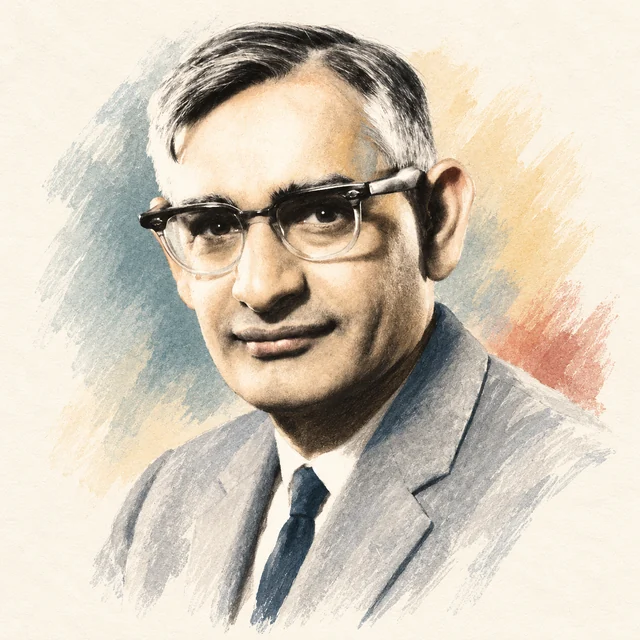
Khorana’s autobiography notes that his exact birth date was uncertain; 1922 is the documented year used here. He grew up in Punjab and studied at Punjab University in Lahore. A Government of India fellowship took him to Liverpool in 1945 for doctoral work. Postdoctoral research with Prelog in Zurich and work with Kenner and Todd at Cambridge shaped his interest in proteins and nucleic acids. From 1952 he developed research at the British Columbia Research Council, moving to Wisconsin’s Institute for Enzyme Research in 1960. Methods for producing nucleic acids with defined sequences enabled systematic tests of how RNA information relates to amino-acid sequences. Wisconsin was his 1968 affiliation. His MIT appointment began in 1970; later gene-synthesis achievements are distinct from the work recognised by this award.
The contribution
Khorana developed defined nucleic-acid sequences that helped interpret the genetic code. He received one third of the Medicine Prize.
The idea in plain language
Nirenberg and Matthaei used a cell-free bacterial system with synthetic RNA. In 1961, repeated uracil in the template directed formation of a phenylalanine-rich chain. This was a crucial clue; the original paper did not yet establish the size of a code unit.
Read the full award story ↗