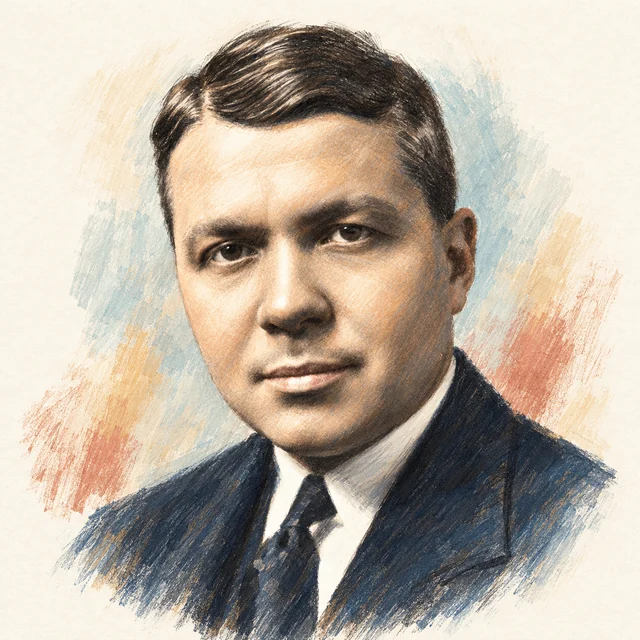
A life in context
The person behind the prize
Urey taught in rural schools before studying zoology at the University of Montana, graduating in 1917. Industrial chemistry and teaching preceded his Berkeley doctorate in chemistry in 1923. A year with Niels Bohr in Copenhagen and work at Johns Hopkins broadened his interest in atomic and molecular structure. He joined Columbia in 1929. There he pursued evidence that hydrogen might include a heavier isotope. In 1931 Ferdinand Brickwedde prepared enriched samples at the National Bureau of Standards, while Urey and George Murphy examined their spectra at Columbia. Their first report appeared in January 1932. Urey received the full 1934 Chemistry Prize for discovering heavy hydrogen, called deuterium. The sole award did not make the research a solitary achievement. His later work on isotope separation, planetary chemistry and the origin of life extended beyond this discovery.
The contribution
Urey received the full Chemistry Prize for discovering heavy hydrogen. His theoretical analysis and spectroscopy, with Brickwedde’s samples and George Murphy’s collaboration, established deuterium as an isotope of hydrogen.
The idea in plain language
Isotopes share the proton number that defines an element, but differ in neutron number. In modern terms, ordinary hydrogen’s nucleus is usually one proton; deuterium contains one proton and one neutron. Both are hydrogen. In 1931 Urey sought direct evidence for the heavier form, using calculations to predict a small shift in its spectral lines and a difference in volatility.
Read the full award story ↗

