c.curionodeThe Nobel Archive

1934 · Chemistry

Finding hydrogen’s heavier relative

Hydrogen seemed the simplest element. Urey and collaborators found that a small fraction of it has greater mass: deuterium, a stable isotope with different physical behaviour.

DeuteriumHeavy hydrogenIsotopesSpectroscopy
1934Chemistry

Visual guide

The prize, pictured

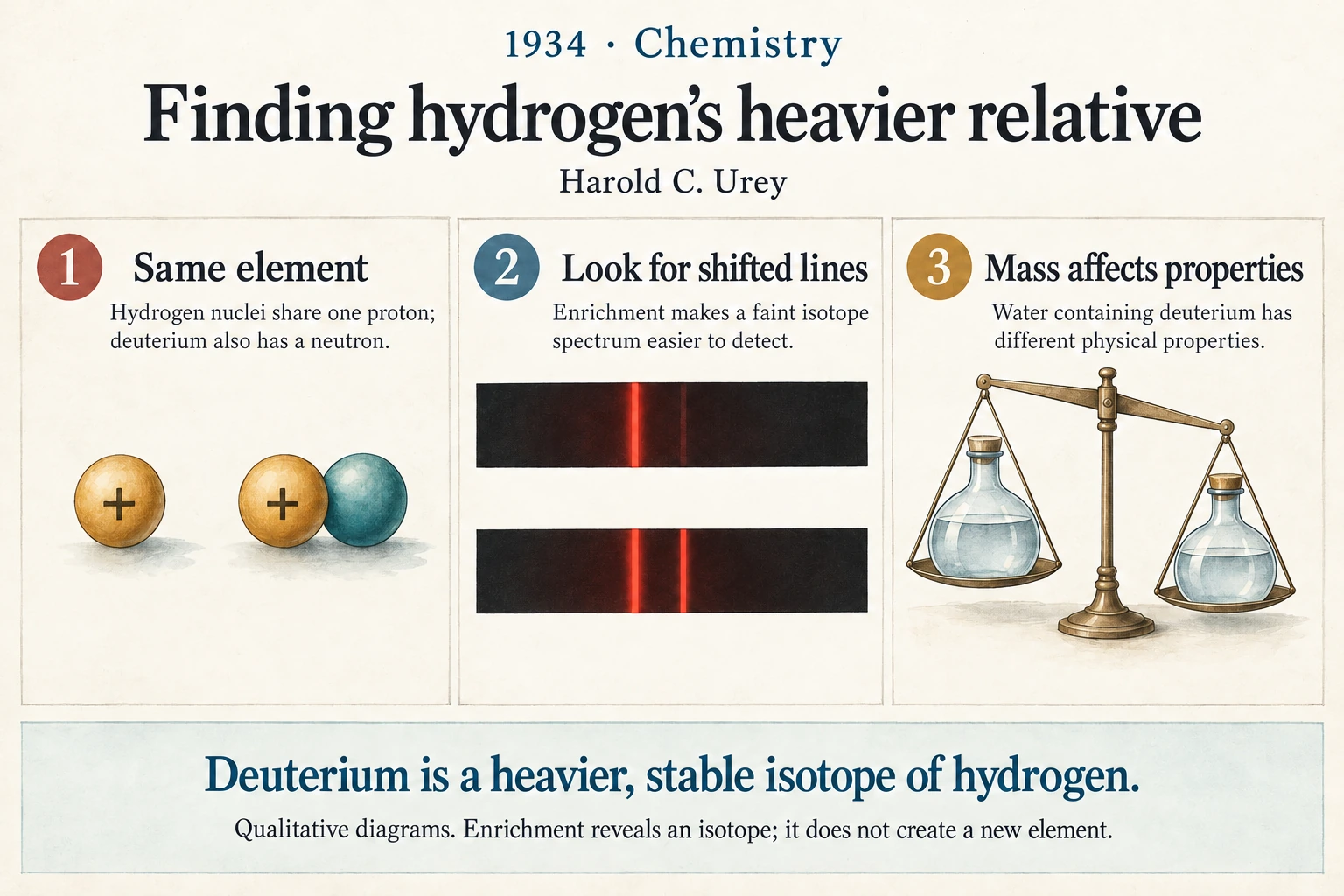
Infographic explaining Finding hydrogen’s heavier relative
Original AI-generated infographic. A conceptual overview; the explanations and sources below provide context.
Read the poster text

Deuterium is a heavier, stable isotope of hydrogen.

  1. Same element

    Hydrogen nuclei share one proton; deuterium also has a neutron.

  2. Look for shifted lines

    Enrichment makes a faint isotope spectrum easier to detect.

  3. Mass affects properties

    Water containing deuterium has different physical properties.

Qualitative diagrams. Enrichment reveals an isotope; it does not create a new element.

01 · The discovery

The idea, in everyday language

Isotopes share the proton number that defines an element, but differ in neutron number. In modern terms, ordinary hydrogen’s nucleus is usually one proton; deuterium contains one proton and one neutron. Both are hydrogen. In 1931 Urey sought direct evidence for the heavier form, using calculations to predict a small shift in its spectral lines and a difference in volatility.

Ferdinand Brickwedde at the National Bureau of Standards prepared samples enriched in the heavier isotope. At Columbia, Urey and George Murphy compared their spectra with ordinary hydrogen and found lines at the predicted positions. Their first report appeared in January 1932. Enrichment made an already existing isotope easier to detect; it did not create a new element. Later separation work and studies of heavy water showed that changing isotopic mass could measurably change physical properties and chemical reaction rates.

Why it matters

The discovery opened a new branch of isotope chemistry. Deuterium became a useful non-radioactive tracer, and heavy water became important in later nuclear research. The 1934 prize recognized heavy hydrogen’s discovery; subsequent applications were developed through much wider work.

02 · The people

Who brought the idea to life?

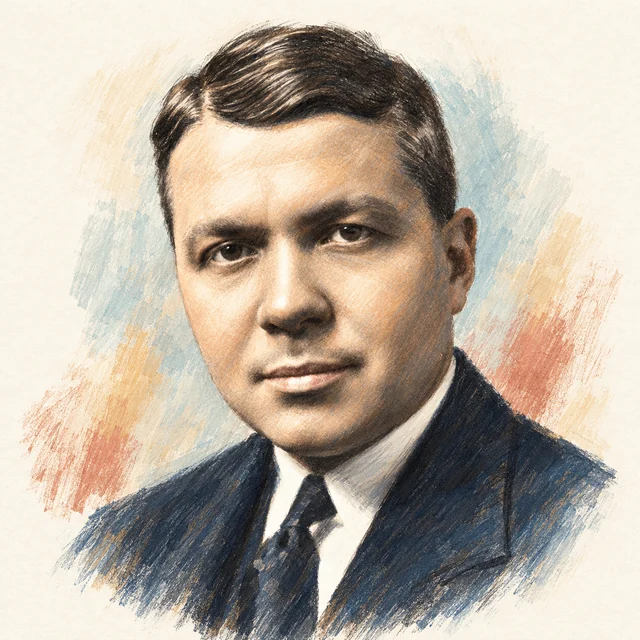
Illustrated portrait of Harold C. Urey

Harold C. Urey

Prize share · 1

Urey received the full Chemistry Prize for discovering heavy hydrogen. His theoretical analysis and spectroscopy, with Brickwedde’s samples and George Murphy’s collaboration, established deuterium as an isotope of hydrogen.

Read the biography ↗

03 · Years in the making

The path here

  1. 1931

    Urey, Brickwedde and George Murphy obtain evidence for heavy hydrogen.

  2. 1932

    Their first report appears in Physical Review in January.

  3. 1934

    Urey receives the Chemistry Prize for the discovery.

04 · Read further

From the original sources

Original explanations by Curionode, based on the official records below. Biographical details and affiliations refer to the award year.

  1. Official award summary nobelprize.org
  2. Award ceremony speech nobelprize.org
  3. NIST: the 1931 deuterium discovery nist.gov
  4. Original paper record: Urey, Brickwedde and Murphy, 1932 journals.aps.org

More in Chemistry

Browse this subject ↗