A life in context
The person behind the prize
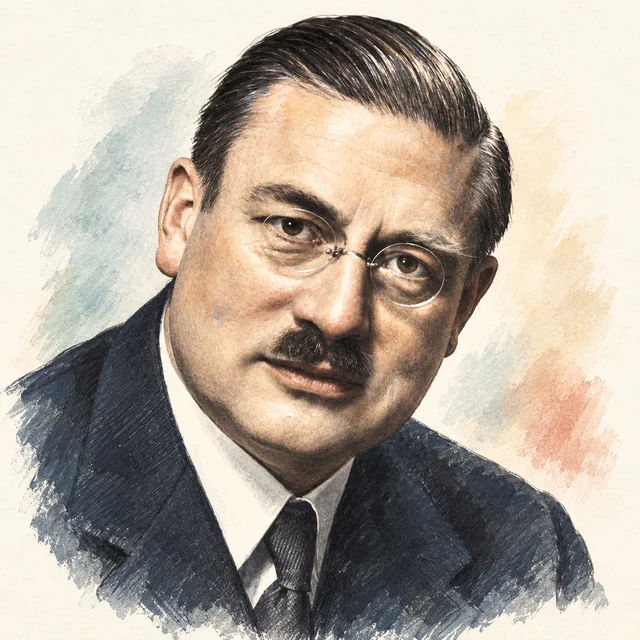
Debye trained in electrical engineering at Aachen and followed Arnold Sommerfeld to Munich, where he received his doctorate in 1908. His appointments took him through Zurich, Utrecht, Göttingen, Zurich again and Leipzig before his Berlin period. He connected mathematical models with experiments that constrained the arrangement of atoms and electric charge in molecules. Dipole measurements revealed charge asymmetry, while X-ray and electron diffraction in gases supplied complementary information about molecular dimensions and geometry. His wider work also included crystal diffraction and electrolyte theory. At the 1936 award he was affiliated with Berlin University and the Kaiser Wilhelm Institute for Physics. His later record under Nazi rule requires context: as president of the German Physical Society, he issued a 1938 letter calling on Jewish members to resign. He subsequently became a professor at Cornell, where his departmental chairmanship began in 1940. The scientific prize does not settle assessments of this political history.
The contribution
Debye received the full Chemistry Prize for methods using dipole moments and X-ray and electron diffraction in gases to investigate molecular structure. These provided measurements against which proposed molecular models could be tested.
The idea in plain language
Two molecules can contain the same kinds and numbers of atoms yet arrange them differently. Debye helped turn structural proposals into models that could be checked against physical measurements. A molecule with an uneven distribution of electric charge has a permanent dipole moment. Its response to an electric field, considered together with thermal motion and induced polarisation, supplies information about charge asymmetry and therefore constrains possible molecular arrangements.
Read the full award story ↗

