A life in context
The person behind the prize
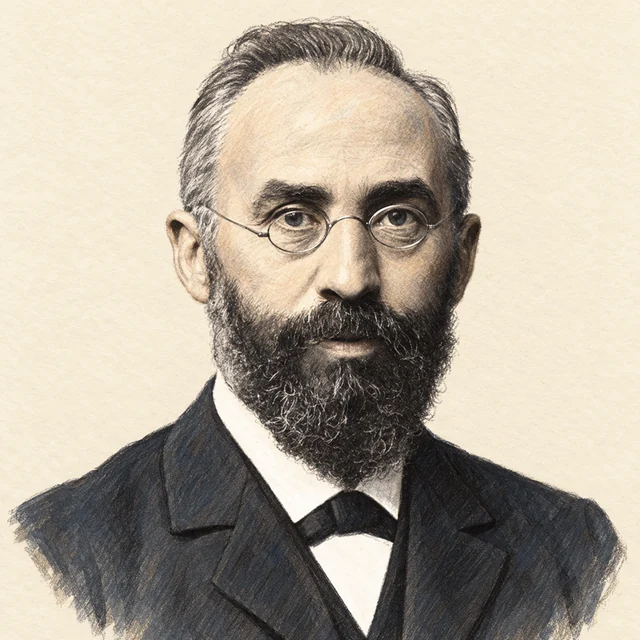
Hendrik Antoon Lorentz grew up in Arnhem and entered Leiden University in 1870. He returned to Arnhem to teach evening classes while preparing his doctorate, awarded in 1875 for work on the reflection and refraction of light. His inaugural lecture at Leiden followed in early 1878. Extending Maxwell’s electromagnetic theory became a central programme of his career. Instead of treating matter only through continuous electrical and magnetic properties, Lorentz developed a description involving small charged constituents. In his electron theory, their motion and response to fields helped connect the behaviour of matter with the propagation and emission of light. A particularly important test arose from Pieter Zeeman’s 1896 investigation of spectral lines in a magnetic field. Zeeman observed changes in the light emitted by matter, including the splitting of a line into components. Lorentz’s theory explained a simple form of the effect and predicted features of the light’s polarisation that could be tested experimentally. The 1902 Physics Prize recognised these complementary theoretical and experimental contributions, awarding each scientist one half. This did not make Lorentz the sole discoverer of the electron, nor did the classical theory explain every spectral pattern later observed. Quantum theory and electron spin were needed for a fuller account. His work on moving bodies and the transformations associated with his name also helped prepare the ground for special relativity, but that later development should be distinguished from the specific 1902 citation. Lorentz continued teaching in Leiden while later working at Teylers in Haarlem, chaired international scientific meetings and contributed to the study of water movements connected with the Zuiderzee project. He died in Haarlem in 1928. His career illustrates a productive exchange between mathematical description and precise observation: theory could suggest what to look for, while results exposed both its strength and its limits.
The contribution
Lorentz developed an electron theory that explained a simple form of the magnetic splitting observed by Zeeman and predicted testable polarisation features. He received one half of the Physics Prize for research connecting magnetism and radiation.
The idea in plain language
A spectrum separates light by wavelength. A narrow emission line provides a precise feature to compare. When the emitting substance is placed in a magnetic field, that line can split into components: the Zeeman effect. The change concerns the source’s emission, not simply a magnet bending a beam travelling through empty space.
Read the full award story ↗