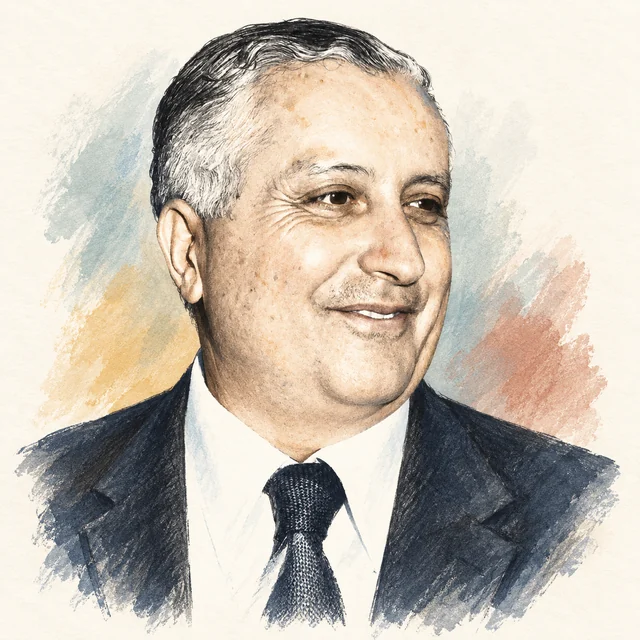
A life in context
The person behind the prize
Prigogine’s family left Russia in 1921, lived in Germany and settled in Belgium in 1929. History, philosophy and piano interested him before he chose chemistry at the Université Libre de Bruxelles, where he received his doctorate in 1941. Théophile De Donder’s work on irreversible processes and Jean Timmermans’s experimental thermodynamics shaped his research. In 1945 he formulated a minimum-entropy-production result for a restricted near-equilibrium regime. The harder question was how systems behave far from equilibrium. With Paul Glansdorff and other collaborators, he developed stability analyses and the concept of dissipative structures: organised patterns sustained by exchanges with the environment. Brussels and Texas supported this work. The theory respects the second law and does not establish universal laws of social behaviour or explain all biological organisation.
The contribution
Prigogine received the full Chemistry Prize for non-equilibrium thermodynamics, especially dissipative structures. Local organisation can arise under suitable driven conditions while irreversible processes still produce entropy overall.
The idea in plain language
A system at equilibrium has no sustained macroscopic driving flows. An open system can instead receive energy or matter and release heat or products. Under suitable conditions, nonlinear interactions and fluctuations can lead to new stable patterns, such as convection or oscillating chemical behaviour. Prigogine’s dissipative structures describe organisation maintained by irreversible processes and environmental exchanges.
Read the full award story ↗

