01 · The discovery
The idea, in everyday language
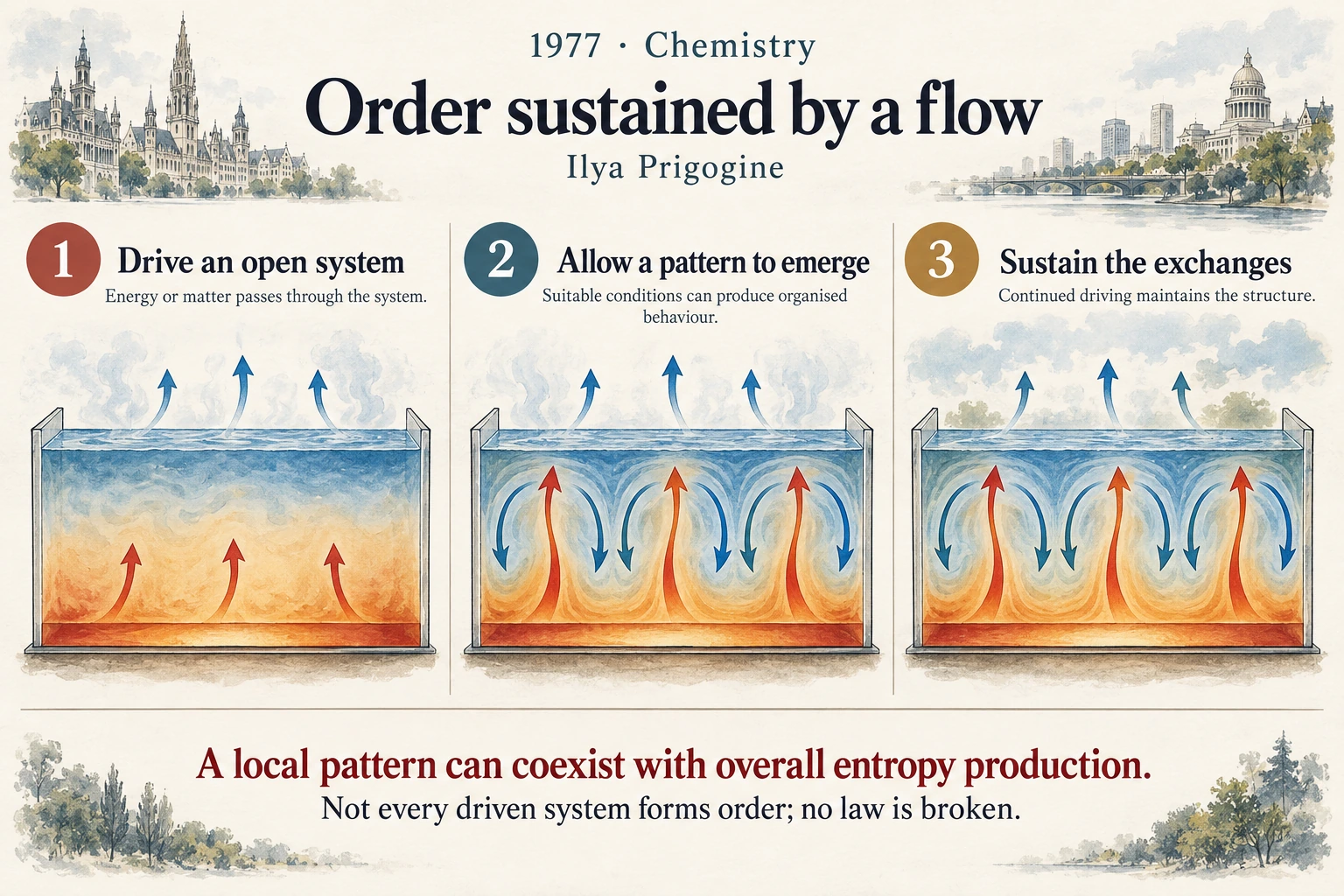
A system at equilibrium has no sustained macroscopic driving flows. An open system can instead receive energy or matter and release heat or products. Under suitable conditions, nonlinear interactions and fluctuations can lead to new stable patterns, such as convection or oscillating chemical behaviour. Prigogine’s dissipative structures describe organisation maintained by irreversible processes and environmental exchanges.
His near-equilibrium minimum-entropy-production result was restricted to a particular linear regime. Far-from-equilibrium behaviour required different stability analyses, developed with Glansdorff and other collaborators. A local pattern is compatible with the second law: the system and surroundings must be considered together. The theory does not mean that every driven system becomes orderly or that entropy universally decreases.
Why it matters
The work expanded thermodynamics beyond equilibrium and supported study of pattern formation in physical and chemical systems. It supplied ways to ask when a steady state loses stability and a different form of organisation becomes possible, with applications depending on the particular system.